Your shopping cart is empty!
« back
« back
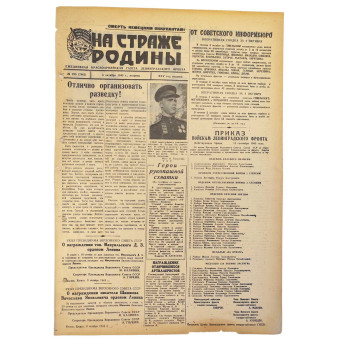
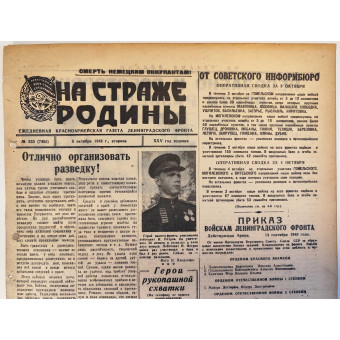
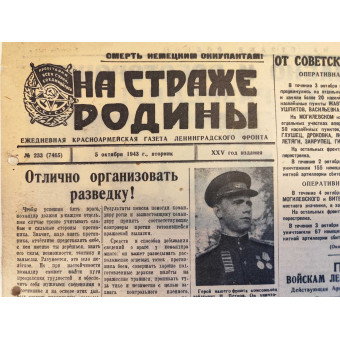
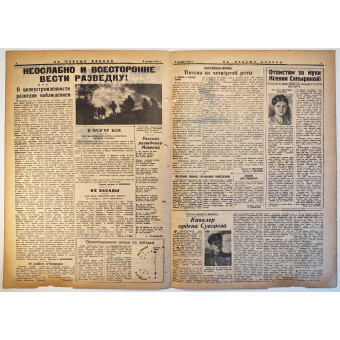
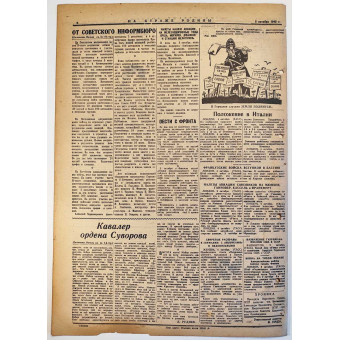
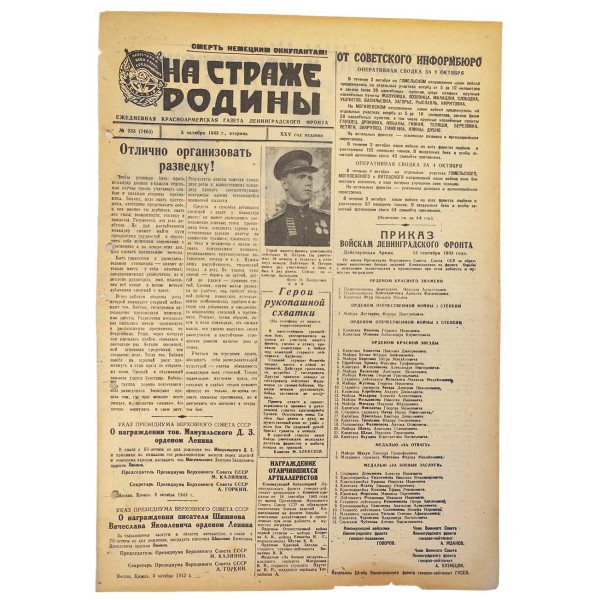
Daily newspaper "On Guard of the Motherland", October 5, 1943
Product Code: a16/63
Out of stock
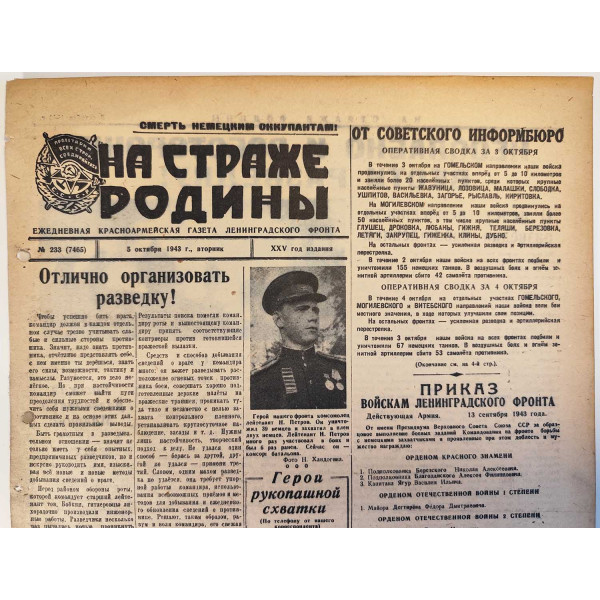
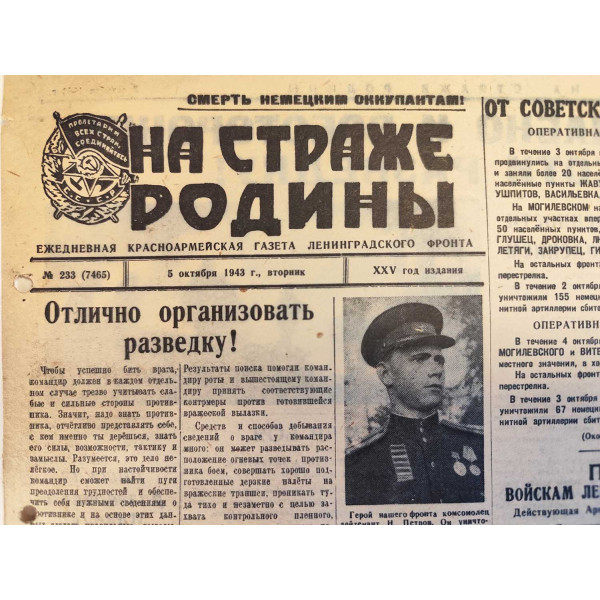
DEATH TO THE GERMAN OCCUPIERS!
ON GUARD OF THE MOTHERLAND
DAILY RED ARMY NEWSPAPER OF THE LENINGRAD FRONT
No. 233 (7465) 5 October 1943, Tuesday 25th year of publication
Organize reconnaissance excellently!
In order to successfully strike the enemy, a commander in every squad must be able to take the situation into account correctly and see the enemy. This means he must know the enemy, track his movements, and not allow him to hold on to cover and approaches.
Naturally, this is not an easy task. But with persistence and skill, difficulties are overcome and the success of the operation is ensured.
Reconnaissance at the front line has great importance for the fighter’s work.
To organize reconnaissance successfully, each fighter must be armed with the ability to use observation, the sharpness of his eye, and the ability to orient himself on the ground.
A bold and determined fighter studies the terrain, notices the slightest changes, and marks approaches.
The results of the search helped the company and platoon commander, in carrying out the order, to take the appropriate defensive measures against an enemy preparing an attack.
Among the methods he uses to obtain information about the enemy are ambushes, sudden raids, and reconnaissance by crawling forward.
Thus, a group of scouts established that there was an enemy machine gun near the slope of a ravine. They silently crawled up to it. The squad leader picked his men. Taking advantage of the situation, they threw grenades. The German machine gunners were destroyed.
In another case, the scouts began observing the enemy’s movements. They saw German soldiers gathering in a grove. The company commander brought up a platoon. The enemy ended up in a ring.
The fighters boldly rushed into the grove. The Germans, trying to run out, came under fire.
(…)
The company commander must train his reconnaissance men in a harsh combat environment, in the difficulties of the offensive and the defence.
Decree of the Presidium of the Supreme Soviet of the USSR
On awarding Comrade D. Z. Manuilsky the Order of Lenin
In connection with the 60th anniversary of the birth of Comrade D. Z. Manuilsky and taking into account his services to the state, to award Comrade Manuilsky the Order of Lenin.
Chairman of the Presidium of the Supreme Soviet of the USSR M. Kalinin
Secretary of the Presidium of the Supreme Soviet of the USSR A. Gorkin
Moscow, Kremlin, 3 October 1943
On awarding the writer Vyacheslav Yakovlevich Shishkov the Order of Lenin
For merits in the field of literature, to award the writer V. Ya. Shishkov the Order of Lenin.
Chairman of the Presidium of the Supreme Soviet of the USSR M. Kalinin
Secretary of the Presidium of the Supreme Soviet of the USSR A. Gorkin
Moscow, Kremlin, 4 October 1943
From the Soviet Information Bureau
Operational summary for 3 October
During 3 October, in the GOMEL direction, our troops advanced on individual sectors by 5 to 10 kilometres and captured more than 20 settlements, among them the large localities of Zhavrushi, Lozovitsa, Mashki, Sloboda, Ushpitov, Vasilievka, Zagorye, Ryslavl, Kirillovka.
In the MOGILEV direction, our troops advanced by 5 to 10 kilometres and captured more than 10 settlements.
In the VITEBSK direction, our units conducted offensive battles.
On the remaining fronts there was intensified reconnaissance and artillery duelling.
During 3 October, our troops on all fronts knocked out and destroyed 155 German tanks. In air battles and by antiaircraft fire, 42 enemy aircraft were shot down.
Operational summary for 4 October
During 4 October, on individual sectors of the GOMEL, MOGILEV, and VITEBSK directions there were local engagements.
In air battles, 53 enemy aircraft were shot down.
(Conclusion on page 4.)
Order to the troops of the Leningrad Front
Active Army. 13 September 1943.
In execution of the Decree of the Presidium of the Supreme Soviet of the USSR, for exemplary performance of combat tasks of the Front Command, to award with the Orders of the Red Banner, the Patriotic War and the Red Star the best fighters and commanders who have shown valour in battle:
Order of the Red Banner
Colonel Nikolai Alekseevich Levintsov
Lieutenant Colonel Aleksei Filippovich Blagoveshchensky
Captain Aleksandr Semyonovich Mikhailov
(further list…)
Order of the Patriotic War, 1st Class
Major Fyodor Dmitrievich Degtyaryov
(…)
Order of the Patriotic War, 2nd Class
Captain Georgii Nikolaevich Ivanov
Captain Aleksandr Karpovich Osipov
(…)
Order of the Red Star
(a long list of awardees…)
Medal “For Courage”
(…)
Medal “For Battle Merit”
(…)
Chief of Staff of the Leningrad Front
Lieutenant General Gusev
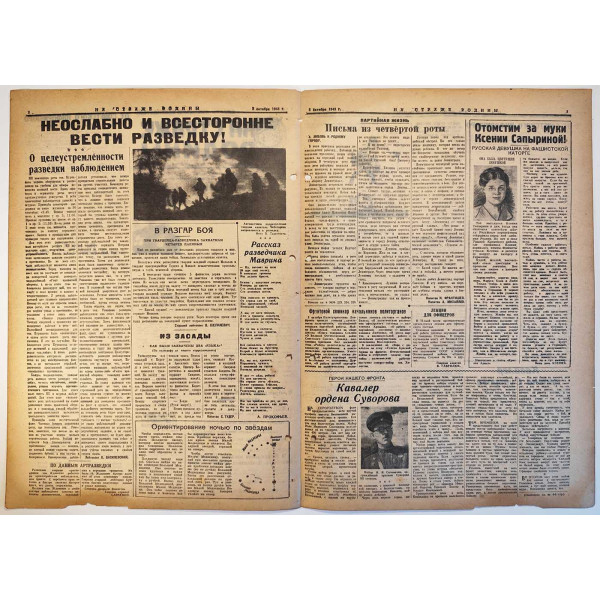
[Page 2]
Conduct reconnaissance relentlessly and in all directions!
On the single-mindedness of reconnaissance by observation
Our scouts watch day and night over the enemy’s movements. The commanders of sub-units are strengthening observation posts.
(…)
In conditions of fog and rain, scouts managed to crawl unnoticed to a height from which the German trenches could be seen.
One of the fighters observed for several hours, accurately determining the location of the Germans’ mortar positions.
This information made it possible to destroy the enemy mortar battery with accurate salvo fire.
(A large column about methods of reconnaissance observation…)
In the thick of the battle
A type of partisan reconnaissance raid.
Our reconnaissance group penetrated the enemy’s positions. They burst suddenly into a dugout and killed the men on duty there.
Sergeant (…) threw a grenade.
When the Germans tried to withdraw, the scouts opened point-blank fire.
(…)
The story of scout Mavrin
Mavrin describes how, during an operation, he crawled up to a highway along which enemy vehicles were moving. He managed, without being noticed, to fix an observation marker on a tree.
(…)
From an ambush
How our men captured another “tongue.”
The scouts lay motionless for several hours, letting the first enemy group pass. When a German officer with two soldiers came close, they instantly jumped up and rushed forward.
(…)
Orienting by the stars at night
A brief instruction for fighters on how to find the Pole Star, determine direction of movement, and deploy units at night.
[Page 3]
Letters from the Fourth Company
The fighters write home about the feats of their comrades and thank their families for their letters.
One of the fighters tells how they destroyed a German machine-gun post.
Another writes about how they repelled a counterattack.
(A large block of correspondence…)
We shall avenge the torment of Kseniya Sapyrina!
A Russian girl in fascist slavery
She was seized by the fascists.
She was beaten, mocked, forced to work beyond her strength.
At night she tried to escape but was caught again.
For trying to escape, Kseniya was thrown into a pit and kept without bread or water.
(A grim article about the Germans’ atrocities against the captured girl.)
Hero of our front – Cavalier of the Order of Suvorov
Major N. I. S… distinguished himself in the battles for (…).
He skilfully organized the defence, destroyed several enemy tanks, and held a sector where the German chains had broken through.
(A detailed biography…)
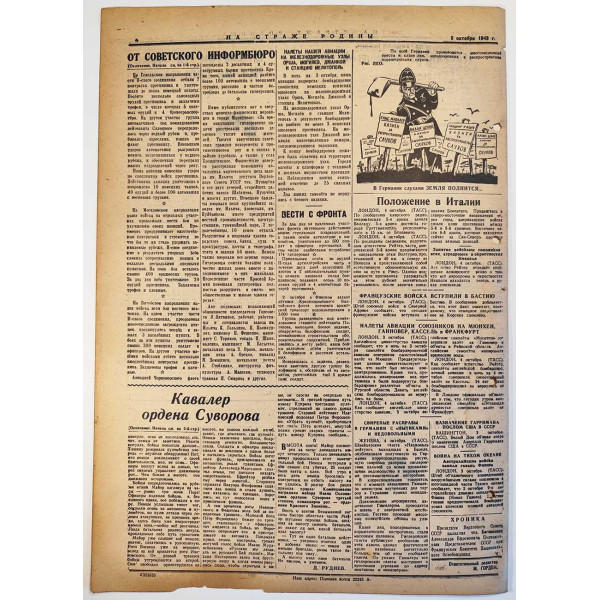
[Page 4]
From the Soviet Information Bureau
(Conclusion. Beginning on page 1.)
Units of our army advanced by 4 to 7 kilometres.
In fierce battles, up to 1,000 enemy soldiers and officers were destroyed.
On the sector (…) 11 German tanks were knocked out.
(…)
Large trophies were taken: dozens of mortars, up to 200 vehicles, hundreds of rifles.
(…)
Raids by our aviation on the railway junctions Orsha, Mogilev, Dyatkovo and Melitopol station
In the night of 3 October our aircraft struck at trains and depots.
(list of targets…)
News from the front
During the day on various sectors of the front, stubborn fighting continued.
The enemy is retreating; our units are pursuing him.
(…)
The situation in Italy
London (TASS).
Badoglio’s headquarters reports that the Allies are advancing.
On certain sectors German resistance has been broken.
(…)
French troops entered Bastia
London (…)
Allied air raids on Munich, Hanover, Kassel and Frankfurt
London (TASS).
During the night the British carried out several mass raids.
(…)
Savage reprisals by the Germans in the Netherlands
Geneva (TASS).
The fascists have arrested hundreds of patriots.
(…)
The intention of Harriman to visit the USA
Washington (TASS).
(…)
Chronicle
Brief information on foreign events.
(…)
Our address: Field Post 22245 A.
Responsible editor
M. Gordon.
Description
DEATH TO THE GERMAN OCCUPIERS!
ON GUARD OF THE MOTHERLAND
DAILY RED ARMY NEWSPAPER OF THE LENINGRAD FRONT
No. 233 (7465) 5 October 1943, Tuesday 25th year of publication
Organize reconnaissance excellently!
In order to successfully strike the enemy, a commander in every squad must be able to take the situation into account correctly and see the enemy. This means he must know the enemy, track his movements, and not allow him to hold on to cover and approaches.
Naturally, this is not an easy task. But with persistence and skill, difficulties are overcome and the success of the operation is ensured.
Reconnaissance at the front line has great importance for the fighter’s work.
To organize reconnaissance successfully, each fighter must be armed with the ability to use observation, the sharpness of his eye, and the ability to orient himself on the ground.
A bold and determined fighter studies the terrain, notices the slightest changes, and marks approaches.
The results of the search helped the company and platoon commander, in carrying out the order, to take the appropriate defensive measures against an enemy preparing an attack.
Among the methods he uses to obtain information about the enemy are ambushes, sudden raids, and reconnaissance by crawling forward.
Thus, a group of scouts established that there was an enemy machine gun near the slope of a ravine. They silently crawled up to it. The squad leader picked his men. Taking advantage of the situation, they threw grenades. The German machine gunners were destroyed.
In another case, the scouts began observing the enemy’s movements. They saw German soldiers gathering in a grove. The company commander brought up a platoon. The enemy ended up in a ring.
The fighters boldly rushed into the grove. The Germans, trying to run out, came under fire.
(…)
The company commander must train his reconnaissance men in a harsh combat environment, in the difficulties of the offensive and the defence.
Decree of the Presidium of the Supreme Soviet of the USSR
On awarding Comrade D. Z. Manuilsky the Order of Lenin
In connection with the 60th anniversary of the birth of Comrade D. Z. Manuilsky and taking into account his services to the state, to award Comrade Manuilsky the Order of Lenin.
Chairman of the Presidium of the Supreme Soviet of the USSR M. Kalinin
Secretary of the Presidium of the Supreme Soviet of the USSR A. Gorkin
Moscow, Kremlin, 3 October 1943
On awarding the writer Vyacheslav Yakovlevich Shishkov the Order of Lenin
For merits in the field of literature, to award the writer V. Ya. Shishkov the Order of Lenin.
Chairman of the Presidium of the Supreme Soviet of the USSR M. Kalinin
Secretary of the Presidium of the Supreme Soviet of the USSR A. Gorkin
Moscow, Kremlin, 4 October 1943
From the Soviet Information Bureau
Operational summary for 3 October
During 3 October, in the GOMEL direction, our troops advanced on individual sectors by 5 to 10 kilometres and captured more than 20 settlements, among them the large localities of Zhavrushi, Lozovitsa, Mashki, Sloboda, Ushpitov, Vasilievka, Zagorye, Ryslavl, Kirillovka.
In the MOGILEV direction, our troops advanced by 5 to 10 kilometres and captured more than 10 settlements.
In the VITEBSK direction, our units conducted offensive battles.
On the remaining fronts there was intensified reconnaissance and artillery duelling.
During 3 October, our troops on all fronts knocked out and destroyed 155 German tanks. In air battles and by antiaircraft fire, 42 enemy aircraft were shot down.
Operational summary for 4 October
During 4 October, on individual sectors of the GOMEL, MOGILEV, and VITEBSK directions there were local engagements.
In air battles, 53 enemy aircraft were shot down.
(Conclusion on page 4.)
Order to the troops of the Leningrad Front
Active Army. 13 September 1943.
In execution of the Decree of the Presidium of the Supreme Soviet of the USSR, for exemplary performance of combat tasks of the Front Command, to award with the Orders of the Red Banner, the Patriotic War and the Red Star the best fighters and commanders who have shown valour in battle:
Order of the Red Banner
Colonel Nikolai Alekseevich Levintsov
Lieutenant Colonel Aleksei Filippovich Blagoveshchensky
Captain Aleksandr Semyonovich Mikhailov
(further list…)
Order of the Patriotic War, 1st Class
Major Fyodor Dmitrievich Degtyaryov
(…)
Order of the Patriotic War, 2nd Class
Captain Georgii Nikolaevich Ivanov
Captain Aleksandr Karpovich Osipov
(…)
Order of the Red Star
(a long list of awardees…)
Medal “For Courage”
(…)
Medal “For Battle Merit”
(…)
Chief of Staff of the Leningrad Front
Lieutenant General Gusev
[Page 2]
Conduct reconnaissance relentlessly and in all directions!
On the single-mindedness of reconnaissance by observation
Our scouts watch day and night over the enemy’s movements. The commanders of sub-units are strengthening observation posts.
(…)
In conditions of fog and rain, scouts managed to crawl unnoticed to a height from which the German trenches could be seen.
One of the fighters observed for several hours, accurately determining the location of the Germans’ mortar positions.
This information made it possible to destroy the enemy mortar battery with accurate salvo fire.
(A large column about methods of reconnaissance observation…)
In the thick of the battle
A type of partisan reconnaissance raid.
Our reconnaissance group penetrated the enemy’s positions. They burst suddenly into a dugout and killed the men on duty there.
Sergeant (…) threw a grenade.
When the Germans tried to withdraw, the scouts opened point-blank fire.
(…)
The story of scout Mavrin
Mavrin describes how, during an operation, he crawled up to a highway along which enemy vehicles were moving. He managed, without being noticed, to fix an observation marker on a tree.
(…)
From an ambush
How our men captured another “tongue.”
The scouts lay motionless for several hours, letting the first enemy group pass. When a German officer with two soldiers came close, they instantly jumped up and rushed forward.
(…)
Orienting by the stars at night
A brief instruction for fighters on how to find the Pole Star, determine direction of movement, and deploy units at night.
[Page 3]
Letters from the Fourth Company
The fighters write home about the feats of their comrades and thank their families for their letters.
One of the fighters tells how they destroyed a German machine-gun post.
Another writes about how they repelled a counterattack.
(A large block of correspondence…)
We shall avenge the torment of Kseniya Sapyrina!
A Russian girl in fascist slavery
She was seized by the fascists.
She was beaten, mocked, forced to work beyond her strength.
At night she tried to escape but was caught again.
For trying to escape, Kseniya was thrown into a pit and kept without bread or water.
(A grim article about the Germans’ atrocities against the captured girl.)
Hero of our front – Cavalier of the Order of Suvorov
Major N. I. S… distinguished himself in the battles for (…).
He skilfully organized the defence, destroyed several enemy tanks, and held a sector where the German chains had broken through.
(A detailed biography…)
[Page 4]
From the Soviet Information Bureau
(Conclusion. Beginning on page 1.)
Units of our army advanced by 4 to 7 kilometres.
In fierce battles, up to 1,000 enemy soldiers and officers were destroyed.
On the sector (…) 11 German tanks were knocked out.
(…)
Large trophies were taken: dozens of mortars, up to 200 vehicles, hundreds of rifles.
(…)
Raids by our aviation on the railway junctions Orsha, Mogilev, Dyatkovo and Melitopol station
In the night of 3 October our aircraft struck at trains and depots.
(list of targets…)
News from the front
During the day on various sectors of the front, stubborn fighting continued.
The enemy is retreating; our units are pursuing him.
(…)
The situation in Italy
London (TASS).
Badoglio’s headquarters reports that the Allies are advancing.
On certain sectors German resistance has been broken.
(…)
French troops entered Bastia
London (…)
Allied air raids on Munich, Hanover, Kassel and Frankfurt
London (TASS).
During the night the British carried out several mass raids.
(…)
Savage reprisals by the Germans in the Netherlands
Geneva (TASS).
The fascists have arrested hundreds of patriots.
(…)
The intention of Harriman to visit the USA
Washington (TASS).
(…)
Chronicle
Brief information on foreign events.
(…)
Our address: Field Post 22245 A.
Responsible editor
M. Gordon.
Payment & Delivery