Your shopping cart is empty!
« back
« back
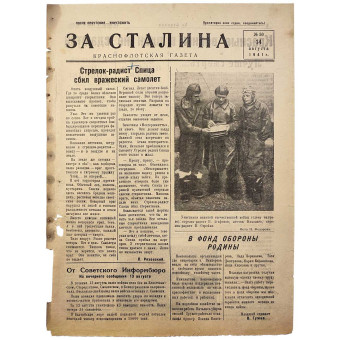
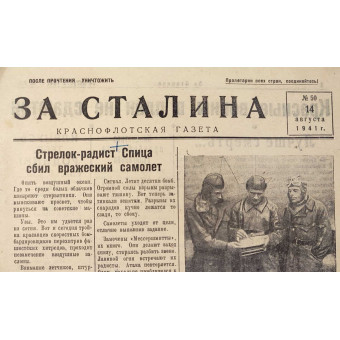
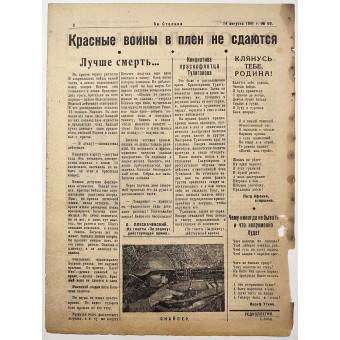
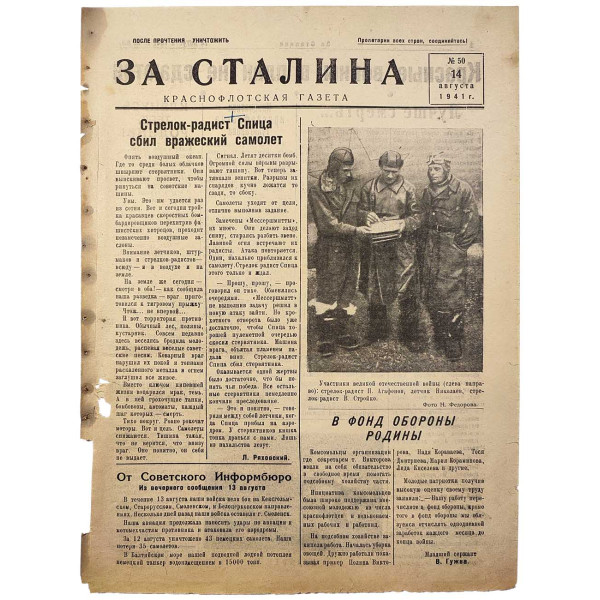
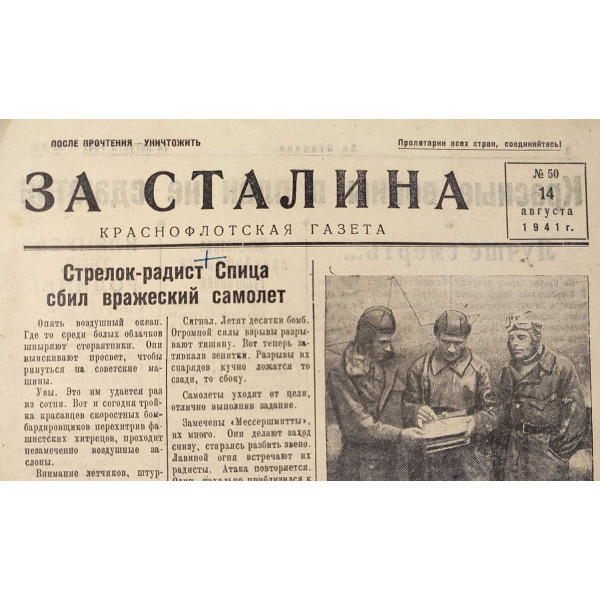
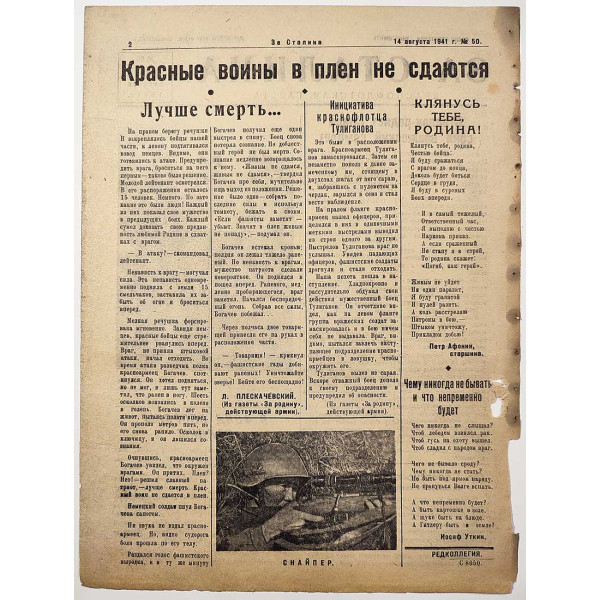
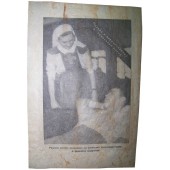
"For Stalin" dated August 14, 1941
Product Code: a16/16
Out of stock
ZA STALINA
Red Navy Newspaper
No. 50, August 14, 1941
Since all copies of this newspaper were destroyed, as indicated by the inscription "Destroy after reading" in the upper-left corner, this surviving copy originates from the collection of the Twice Red Banner Baltic Fleet Museum in Tallinn during Soviet times, whose library was discarded when the museum relocated to Kaliningrad.
Top-left corner: "DESTROY AFTER READING"
Top-right slogan: "Workers of the world, unite!"
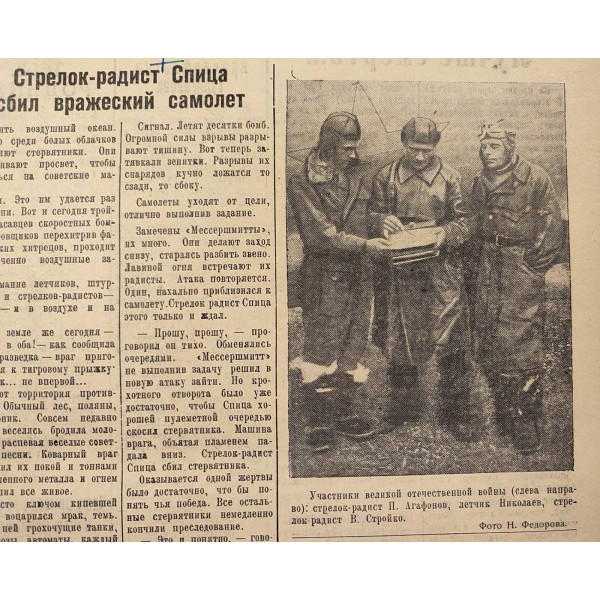
Radio Gunner Spitsa Shoots Down Enemy Aircraft
Once again, the air is an ocean. Somewhere among white clouds, vultures circle, seeking prey to please their leader.
Alas, only rarely does their effort succeed. Today, a trio of vultures gathered to bomb a non-secret French kilters’ [possibly coded or distorted term] ship passing along the northern polar border.
The attention of gunners, navigators, and all fighters in the air is at maximum tension.
Aircraft squadrons rush furiously across the sky. Cannons and machine guns fire, bombs roar. From the sea comes the response of torpedoes and the tiger-like growl of cannons. This is nothing new...
Now approaching enemy territory. Usually here, raising vultures, enemy planes repeatedly attack. Our helmsman skillfully dodges and turns to avoid sinking.
Instead of bombs and daggers, machine-gun fire rings out, shells whistle, heavy bombs explode, and motors roar amidst the noise of battle.
Around is silence. Engines hum steadily. And finally, landing. The plane descends. The silence is so profound it's hard to believe the enemy is nearby... understandable, since he gives no sign.
Spitsa flies his tenth battle. Powerful explosions break the silence. Now the engine buzzes. Shell bursts behind, but we must wait for them to appear behind and beside.
Aircraft retreat from their targets, mission accomplished.
Messerschmitts detected—many of them. They attack, trying to break up our formation. Our guns answer sharply. Another attack, close to the fuselage. Radio gunner Spitsa fires accurately.
"Cannon," the navigator quietly repeats. Gunfire exchange ensues. A Messerschmitt begins falling, trailing smoke. But the enemy persists. However, the enemy had confidence that Spitsa destroyed another vulture. The enemy’s plane, now aflame, falls down. Radio gunner Spitsa has shot down the vulture.
One victim was enough to hasten victory. All vulture aircraft immediately turned to flee.
“That’s what he’s trying,” said the pilot to himself, who heard Hitlerite daggers near the airfield. The enemy fights us only with fists and teeth.
P. Rakhovskiy.
From Soviet Information Bureau
Evening report, August 13:
On August 13, our troops fought in the Kexholm, Staraya Russa, Smolensk, and Zhitomir areas. A few days ago, our forces withdrew from Smolensk.
Our aviation continues attacking enemy air and motorized units and enemy airfields.
On August 12, 43 German aircraft were destroyed. Our losses were 35 aircraft.
In the Baltic Sea, our submarine sank a German tanker displacing 15,000 tons.
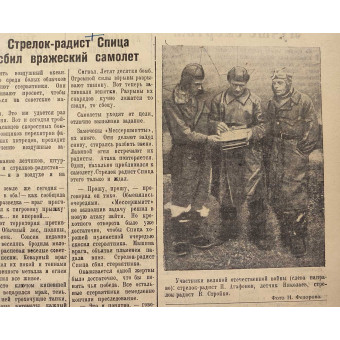
Photo caption:
"Participants of the Great Patriotic War (left to right): Radio gunner P. Agafonov, pilot Nikolaev, radio gunner V. Strokov."
Photo by N. Fedorov.
For the Motherland Defense Fund
Komsomol members led by Secretary T. Viktorov took a pledge in their free time to help the kolkhoz "Air" deliver agricultural products above the planned norms.
The youth initiative was supported by older comrades. Work began immediately.
Vegetable harvesting started vigorously. Another brigade, led directly by Pochiva Viktorova, Nadia Korableva, Tosya Andreeva, Maria Korablinova, Anna Yeleseeva, and others, followed suit.
Young patriots receive high recognition for their labor. Our defense fund grows daily. In ten working days, the monthly earnings for the kolkhoz were collected.
Junior Sergeant V. Guzhva.
Page 2:
Red Soldiers Never Surrender
Death is Preferable…
Our unit entrenched itself on the right bank of a small river, preparing for a new assault. The enemy anticipated this and made its move—but our young lieutenant made his decision. Only 15 men remained at his disposal—not many, but they were our men, each one tested in previous battles, showing what a Red Army soldier must be when the Motherland is in danger!
"Attack!" commanded the lieutenant.
Hatred for the enemy is powerful. This hatred propelled brave, fearless warriors forward. The decision was made—not to step back from fire but charge ahead.
The shallow river was crossed instantly. Seeing the mercilessness of the Red Army soldiers, Hitler’s men pulled back. Unable to withstand the bayonet charge, the enemy retreated. But a fascist grenade exploded at the feet of soldier Bogachev. He was gravely wounded and tried to rise but could not, nor could he imagine surrendering alive. He tried crawling forward. He shouted to comrades he'd rather shoot himself than surrender, and lost consciousness.
When he regained consciousness, soldier Bogachev found himself surrounded by enemies. Captivity? Never! He decided immediately—death was preferable. A German soldier kicked him with his boot.
Bogachev showed no reaction, though a spasm of pain passed through him.
A voice of a fascist sounded, and Bogachev received another bullet in his back, losing consciousness again. Yet, he wasn’t dead. Slowly regaining awareness, he kept repeating to himself, "I will never surrender alive," overcoming the unbearable pain.
What happened next—he gathered all his remaining strength to return to his comrades. Bogachev crawled back toward a machine gun, where a dead gunner lay. Reaching it, the Red Army soldier turned it towards the enemy and opened fire. Half an hour later, two comrades carried him back to safety.
"Comrades!" he growled, "the fascist wanted to finish me off! Never surrender alive! Beat him mercilessly!"
A. Pleskachevskiy.
(From the newspaper "Za Rodinu," active army).
The Initiative of Red Navy Man Tuiganov
This occurred in enemy territory. Red Navy man Tuiganov was camouflaged, crawling slowly towards an enemy bunker that had troubled us. He silenced the enemy position with grenades and reported back.
German machine-gunners spotted him and opened fire. Bullets flew around, but Tuiganov remained unharmed. He continued working, silencing another bunker.
Immediately, our troops responded with mortar and machine-gun fire. The enemy fled in panic.
Tuiganov’s initiative inspired others. On the left flank, our troops engaged and destroyed an enemy ambush.
He quietly withdrew from danger. Soon, this courageous fighter reported the successful results to his command.
(From the newspaper "Za Rodinu," active army).
I Swear to You, Motherland!
I swear to you, Motherland, by soldier's honor,
I will fight until the very end.
My heart and chest will swiftly conceal me,
As I charge forward with weapon in hand.
In frozen snows and desert sands,
No sorrow shall defeat my stance.
There will be no tired eyes in battle,
No complaints, no tears, nor words from us.
I swear to you, Motherland, by soldier's honor!
I ask of your great father,
That in this grievous, deadly year,
He helps defeat the cursed enemy.
Pyotr Afonin, Sergeant.
What Will Never Happen and What Surely Will
What has never been heard?
That the heavens parted once,
That the oak wouldn't wither,
That a tyrant stayed among the people.
What has never occurred ever?
What never can become?
The enemy won't rule the people,
Nor reverse the flow of Volga.
And what surely will be?
The people will rise in battle!
My fate is to fall,
But Hitler's is to rot underground!
Iosif Utkin.
Photo caption below:
"SNIPER."
Bottom page: "EDITORIAL BOARD. C 8060."
Description
ZA STALINA
Red Navy Newspaper
No. 50, August 14, 1941
Since all copies of this newspaper were destroyed, as indicated by the inscription "Destroy after reading" in the upper-left corner, this surviving copy originates from the collection of the Twice Red Banner Baltic Fleet Museum in Tallinn during Soviet times, whose library was discarded when the museum relocated to Kaliningrad.
Top-left corner: "DESTROY AFTER READING"
Top-right slogan: "Workers of the world, unite!"
Radio Gunner Spitsa Shoots Down Enemy Aircraft
Once again, the air is an ocean. Somewhere among white clouds, vultures circle, seeking prey to please their leader.
Alas, only rarely does their effort succeed. Today, a trio of vultures gathered to bomb a non-secret French kilters’ [possibly coded or distorted term] ship passing along the northern polar border.
The attention of gunners, navigators, and all fighters in the air is at maximum tension.
Aircraft squadrons rush furiously across the sky. Cannons and machine guns fire, bombs roar. From the sea comes the response of torpedoes and the tiger-like growl of cannons. This is nothing new...
Now approaching enemy territory. Usually here, raising vultures, enemy planes repeatedly attack. Our helmsman skillfully dodges and turns to avoid sinking.
Instead of bombs and daggers, machine-gun fire rings out, shells whistle, heavy bombs explode, and motors roar amidst the noise of battle.
Around is silence. Engines hum steadily. And finally, landing. The plane descends. The silence is so profound it's hard to believe the enemy is nearby... understandable, since he gives no sign.
Spitsa flies his tenth battle. Powerful explosions break the silence. Now the engine buzzes. Shell bursts behind, but we must wait for them to appear behind and beside.
Aircraft retreat from their targets, mission accomplished.
Messerschmitts detected—many of them. They attack, trying to break up our formation. Our guns answer sharply. Another attack, close to the fuselage. Radio gunner Spitsa fires accurately.
"Cannon," the navigator quietly repeats. Gunfire exchange ensues. A Messerschmitt begins falling, trailing smoke. But the enemy persists. However, the enemy had confidence that Spitsa destroyed another vulture. The enemy’s plane, now aflame, falls down. Radio gunner Spitsa has shot down the vulture.
One victim was enough to hasten victory. All vulture aircraft immediately turned to flee.
“That’s what he’s trying,” said the pilot to himself, who heard Hitlerite daggers near the airfield. The enemy fights us only with fists and teeth.
P. Rakhovskiy.
From Soviet Information Bureau
Evening report, August 13:
On August 13, our troops fought in the Kexholm, Staraya Russa, Smolensk, and Zhitomir areas. A few days ago, our forces withdrew from Smolensk.
Our aviation continues attacking enemy air and motorized units and enemy airfields.
On August 12, 43 German aircraft were destroyed. Our losses were 35 aircraft.
In the Baltic Sea, our submarine sank a German tanker displacing 15,000 tons.
Photo caption:
"Participants of the Great Patriotic War (left to right): Radio gunner P. Agafonov, pilot Nikolaev, radio gunner V. Strokov."
Photo by N. Fedorov.
For the Motherland Defense Fund
Komsomol members led by Secretary T. Viktorov took a pledge in their free time to help the kolkhoz "Air" deliver agricultural products above the planned norms.
The youth initiative was supported by older comrades. Work began immediately.
Vegetable harvesting started vigorously. Another brigade, led directly by Pochiva Viktorova, Nadia Korableva, Tosya Andreeva, Maria Korablinova, Anna Yeleseeva, and others, followed suit.
Young patriots receive high recognition for their labor. Our defense fund grows daily. In ten working days, the monthly earnings for the kolkhoz were collected.
Junior Sergeant V. Guzhva.
Page 2:
Red Soldiers Never Surrender
Death is Preferable…
Our unit entrenched itself on the right bank of a small river, preparing for a new assault. The enemy anticipated this and made its move—but our young lieutenant made his decision. Only 15 men remained at his disposal—not many, but they were our men, each one tested in previous battles, showing what a Red Army soldier must be when the Motherland is in danger!
"Attack!" commanded the lieutenant.
Hatred for the enemy is powerful. This hatred propelled brave, fearless warriors forward. The decision was made—not to step back from fire but charge ahead.
The shallow river was crossed instantly. Seeing the mercilessness of the Red Army soldiers, Hitler’s men pulled back. Unable to withstand the bayonet charge, the enemy retreated. But a fascist grenade exploded at the feet of soldier Bogachev. He was gravely wounded and tried to rise but could not, nor could he imagine surrendering alive. He tried crawling forward. He shouted to comrades he'd rather shoot himself than surrender, and lost consciousness.
When he regained consciousness, soldier Bogachev found himself surrounded by enemies. Captivity? Never! He decided immediately—death was preferable. A German soldier kicked him with his boot.
Bogachev showed no reaction, though a spasm of pain passed through him.
A voice of a fascist sounded, and Bogachev received another bullet in his back, losing consciousness again. Yet, he wasn’t dead. Slowly regaining awareness, he kept repeating to himself, "I will never surrender alive," overcoming the unbearable pain.
What happened next—he gathered all his remaining strength to return to his comrades. Bogachev crawled back toward a machine gun, where a dead gunner lay. Reaching it, the Red Army soldier turned it towards the enemy and opened fire. Half an hour later, two comrades carried him back to safety.
"Comrades!" he growled, "the fascist wanted to finish me off! Never surrender alive! Beat him mercilessly!"
A. Pleskachevskiy.
(From the newspaper "Za Rodinu," active army).
The Initiative of Red Navy Man Tuiganov
This occurred in enemy territory. Red Navy man Tuiganov was camouflaged, crawling slowly towards an enemy bunker that had troubled us. He silenced the enemy position with grenades and reported back.
German machine-gunners spotted him and opened fire. Bullets flew around, but Tuiganov remained unharmed. He continued working, silencing another bunker.
Immediately, our troops responded with mortar and machine-gun fire. The enemy fled in panic.
Tuiganov’s initiative inspired others. On the left flank, our troops engaged and destroyed an enemy ambush.
He quietly withdrew from danger. Soon, this courageous fighter reported the successful results to his command.
(From the newspaper "Za Rodinu," active army).
I Swear to You, Motherland!
I swear to you, Motherland, by soldier's honor,
I will fight until the very end.
My heart and chest will swiftly conceal me,
As I charge forward with weapon in hand.
In frozen snows and desert sands,
No sorrow shall defeat my stance.
There will be no tired eyes in battle,
No complaints, no tears, nor words from us.
I swear to you, Motherland, by soldier's honor!
I ask of your great father,
That in this grievous, deadly year,
He helps defeat the cursed enemy.
Pyotr Afonin, Sergeant.
What Will Never Happen and What Surely Will
What has never been heard?
That the heavens parted once,
That the oak wouldn't wither,
That a tyrant stayed among the people.
What has never occurred ever?
What never can become?
The enemy won't rule the people,
Nor reverse the flow of Volga.
And what surely will be?
The people will rise in battle!
My fate is to fall,
But Hitler's is to rot underground!
Iosif Utkin.
Photo caption below:
"SNIPER."
Bottom page: "EDITORIAL BOARD. C 8060."
Payment & Delivery