Your shopping cart is empty!
« back
« back
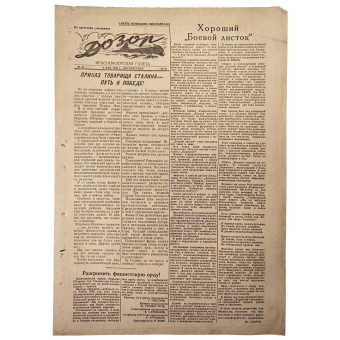
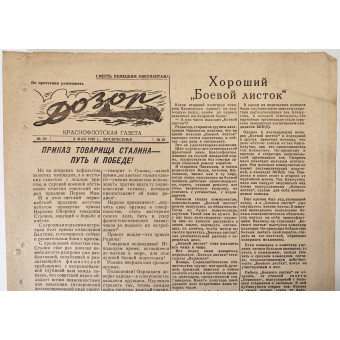
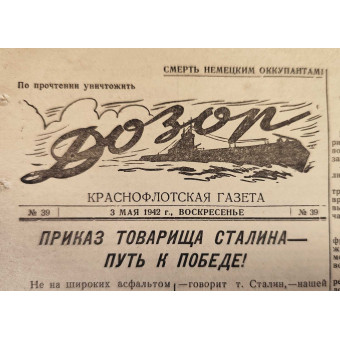
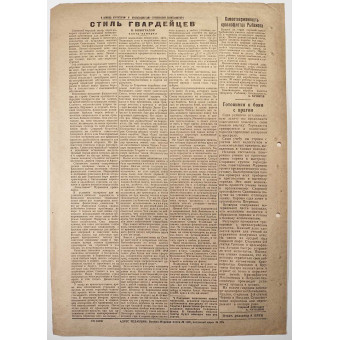
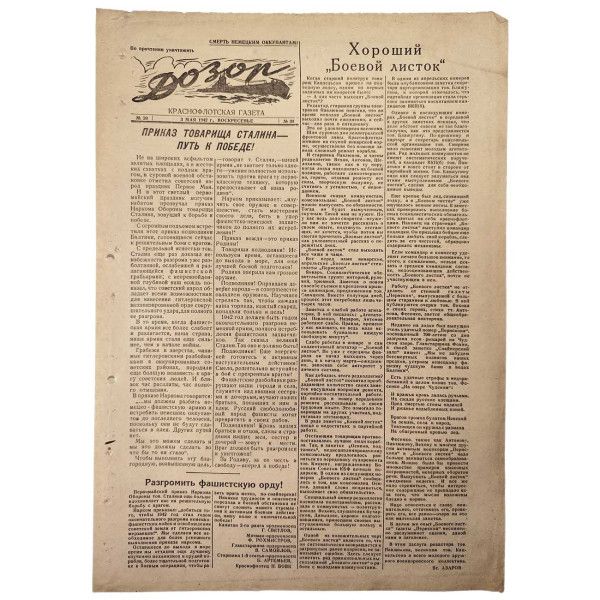
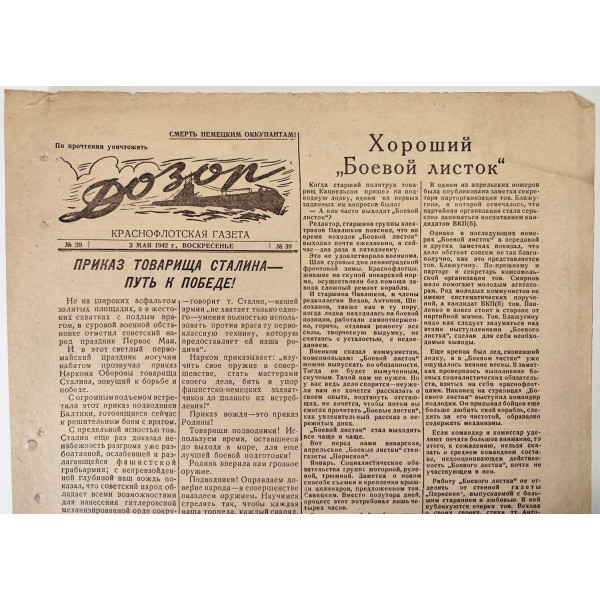
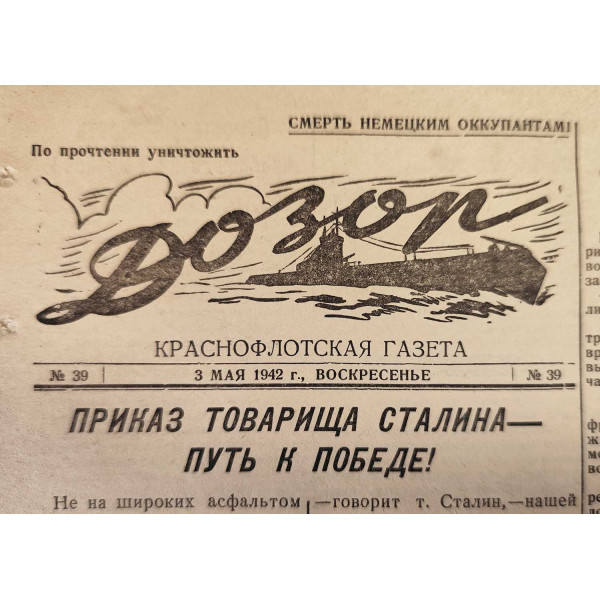
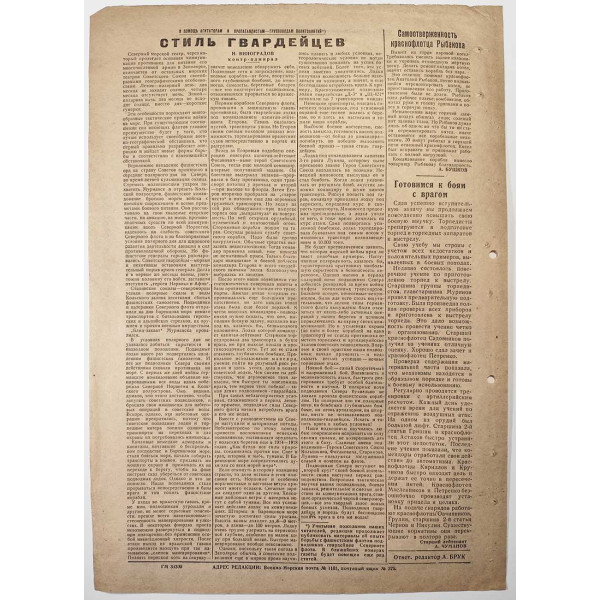
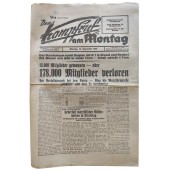
Naval newspaper "Dozor" dated May 3, 1942
Dozor newspaper, No. 39 (May 3, 1942, Sunday)
Naval newspaper of the submariners of the Red Banner Baltic Fleet
Destroy after reading
Death to the German occupiers!
Comrade Stalin’s Order — the Path to Victory!
Not on wide asphalted avenues are our crews now marching in formation. Today, the whole country celebrates May Day amid military surroundings — and it does so with a mighty combat order for the Defense of the Motherland from Comrade Stalin, calling for a fight to the finish.
Submariners of the Baltic Fleet greeted this order with particular emotion, as they prepare for serious military action.
Comrade Stalin once again clearly outlined the impermissibility of slackness, laxity, and disorganization in the fleet. Discipline must be ironclad, conduct must be warlike. The Soviet people possess all means to destroy Hitler’s international horde, which has devoured half of Europe.
While fascist Germany, for over a hundred days, has failed to break us, our country continues to wage a sacred and just war for liberation.
We are smashing the fascist brigands. On the streets and in the villages, the combat order has been met with rallies and mass meetings. It was accepted everywhere as truly a call to arms.
The order says plainly: the fascist army can and must be destroyed — through training and arming every fighter to the core. Until we follow this order, we will not be fully ready for battle. There is no other way.
We must not wait for someone to tell us what to do.
We must fulfill the order absolutely — with total vengeance.
Crush the Fascist Horde!
Comrade Stalin’s May Day order for the Defense of the Motherland rings especially true against the backdrop of April–May events. May 1, 1942, has become a day of battle — a true fight for freedom, for honor, for truth.
Commanders, naval and navigation units, Red Navy sailors and petty officers are answering the order with mobilization of all strength and combat operations — to crush the fascist horde mercilessly!
Only heroism and selflessness, comrades, can determine the outcome of the war — and of victory.
Miner V. S. Svetlovsky
Chief Petty Officer R. M. Yurovsky
Petty Officer 1st Class S. V. Artemyev
Red Navy Sailor I. Vovk
A Good "Combat Bulletin"
When Senior Political Officer Comrade Antonov recently reviewed the materials of the combat wall newspaper, he remarked with satisfaction:
“We must publish the combat bulletin more often.”
The editor, chief instructor of the group, prepared the bulletin together with activists. This was a newspaper written by hand and by heart.
It was well formatted — with a proper masthead, photos, captions, and sections. These included: "Mistakes," "Honor Board," "For Lenin’s Watch," and more.
There were good drawings — signed by Komsomol members and Red Navy sailors.
This was a combat bulletin that responded vividly to Comrade Stalin’s orders.
It printed statements and speeches from commanders, frontline workers, praise of good comrades — all from the heart.
It was issued regularly. Political officers and commanders often signed under it.
Properly organized, the combat bulletin plays an enormous educational role. It should be a vital link between command and the masses.
It must be released like a weapon, ready at any moment.
The combat bulletin can become a true comrade and friend to every sailor.
This newspaper was, beyond any doubt, a real combat bulletin.
If a commander and commissar treat it seriously, it becomes a weapon of political, educational, and operational value.
The combat bulletin must not be formalistic. It must be relevant, alive, and focused.
If it contains falsehood or lacks truth — it will be useless.
This one was compiled with great care. There were many contributors — good letters, useful notes, frontline pieces, responses, and critiques.
It was a newspaper made with spirit, fire, and thought. That’s why it was read with interest.
There are strong parts and weaker ones — but what matters is the serious attitude in preparing it.
Each issue must be an event — reflecting achievements and shortcomings — and serving as a weapon of the Party and the people.
The bulletin prepared by Comrade Antonov is worthy of the name “combat.”
Vs. Azarov
The Guardsman’s Style
By Rear Admiral N. Vinogradov
The Northern Naval Theater, through which passes the main flow of supplies and equipment for England, and to a great extent for the Western Front — this is one of the most important theaters of the Soviet Union.
Heroic conditions that are unknown elsewhere have persisted here for many months.
Banners and slogans are not seen here — everything happens silently and simply. Here, the place of the heroic deed is everyday reality.
In these conditions, many qualities become visible that would otherwise go unnoticed.
If the Soviet people did not recognize this style of heroism, they would not recognize how Soviet men fight.
In one of his speeches, Comrade Stalin said that there is no need to introduce a new title to acknowledge the heroism of people whose feats are equal to — or even exceed — those of regular soldiers.
At the height of the fascist onslaught, the Soviet country revealed examples of the highest heroism. Strategy adapted to these conditions included both military and political forms.
Northern conditions are special. Knowledge of convoy defense, of motorboat escort tactics, is essential for anyone who wants to understand the missions of the Northern Fleet.
One convoy passage alone is worth much. Fighting begins as soon as the ships leave Murmansk.
Great endurance is needed in the North. Constant tension, cold, and harsh weather.
Every battle is not only fire, but skill — tactics and knowledge of naval warfare.
Whoever has not seen a boat attack in the polar night, whoever doesn’t know the true essence of these battles — cannot judge the Northern Fleet.
Now that the front is expanding, and operations are developing, it is especially clear that the style of the North has laid a foundation adopted elsewhere.
A true Guardsman is not just someone wearing a badge. It’s restraint, precision, diligence.
It is respect for the Navy and its history. It is memory of those who gave their lives for the North.
Remember the torpedo boat No. 3, helmed by Lushin — personally called by Stalin at the hospital.
A small boat challenged a fascist cruiser — and did not retreat.
When battle ends, it’s time to assess the results. Every flag, every post, every position — all are the outcome of both courage and political consciousness.
We have no "accidental success." We have proven experience. It teaches us now.
The Guardsman’s style is not a slogan. It is an inner core, a daily practice.
Selflessness of Red Navy Sailor Rybakov
A charge in the torpedo launch system was found to have failed.
Upon immediate inspection, it became clear that quick replacement was needed.
Knowing there were 90 atmospheres of pressure in the machine, Red Navy Sailor Rybakov began the repair without hesitation.
He knew the risk. And still, he performed the task quickly and bravely.
Rybakov acted with courage and responsibility. He completed the job in the shortest time possible. The ship’s command issued a commendation.
A. Bulykov
Preparing for Battle with the Enemy
Strength yields to training. We must raise our combat skills steadily.
Torpedo operators practice daily — aiming, adjusting, preparing the launchers.
We base our training on analyzing all strengths and shortcomings.
Recently, a repeated torpedo drill was held. Senior torpedo specialist Petryakov completed the task excellently — demonstrating great organization.
This made a sudden torpedo encounter possible.
The Red Navy sailors’ shots were precise and confident.
Petryakov earned commendation.
Checks showed mechanics know their systems; torpedo crews are in top form.
Training continues with focus and commitment.
No detail is too small — every screw, every report, every calculation counts.
Artillery section chief Ustinov also performed excellently.
Training reflects real battle conditions. Conclusions are written into bulletins.
All equipment is in full working order. Records are kept strictly.
All ranks took part — commanders, chiefs, sailors.
Editor: A. Bruk
Description
Dozor newspaper, No. 39 (May 3, 1942, Sunday)
Naval newspaper of the submariners of the Red Banner Baltic Fleet
Destroy after reading
Death to the German occupiers!
Comrade Stalin’s Order — the Path to Victory!
Not on wide asphalted avenues are our crews now marching in formation. Today, the whole country celebrates May Day amid military surroundings — and it does so with a mighty combat order for the Defense of the Motherland from Comrade Stalin, calling for a fight to the finish.
Submariners of the Baltic Fleet greeted this order with particular emotion, as they prepare for serious military action.
Comrade Stalin once again clearly outlined the impermissibility of slackness, laxity, and disorganization in the fleet. Discipline must be ironclad, conduct must be warlike. The Soviet people possess all means to destroy Hitler’s international horde, which has devoured half of Europe.
While fascist Germany, for over a hundred days, has failed to break us, our country continues to wage a sacred and just war for liberation.
We are smashing the fascist brigands. On the streets and in the villages, the combat order has been met with rallies and mass meetings. It was accepted everywhere as truly a call to arms.
The order says plainly: the fascist army can and must be destroyed — through training and arming every fighter to the core. Until we follow this order, we will not be fully ready for battle. There is no other way.
We must not wait for someone to tell us what to do.
We must fulfill the order absolutely — with total vengeance.
Crush the Fascist Horde!
Comrade Stalin’s May Day order for the Defense of the Motherland rings especially true against the backdrop of April–May events. May 1, 1942, has become a day of battle — a true fight for freedom, for honor, for truth.
Commanders, naval and navigation units, Red Navy sailors and petty officers are answering the order with mobilization of all strength and combat operations — to crush the fascist horde mercilessly!
Only heroism and selflessness, comrades, can determine the outcome of the war — and of victory.
Miner V. S. Svetlovsky
Chief Petty Officer R. M. Yurovsky
Petty Officer 1st Class S. V. Artemyev
Red Navy Sailor I. Vovk
A Good "Combat Bulletin"
When Senior Political Officer Comrade Antonov recently reviewed the materials of the combat wall newspaper, he remarked with satisfaction:
“We must publish the combat bulletin more often.”
The editor, chief instructor of the group, prepared the bulletin together with activists. This was a newspaper written by hand and by heart.
It was well formatted — with a proper masthead, photos, captions, and sections. These included: "Mistakes," "Honor Board," "For Lenin’s Watch," and more.
There were good drawings — signed by Komsomol members and Red Navy sailors.
This was a combat bulletin that responded vividly to Comrade Stalin’s orders.
It printed statements and speeches from commanders, frontline workers, praise of good comrades — all from the heart.
It was issued regularly. Political officers and commanders often signed under it.
Properly organized, the combat bulletin plays an enormous educational role. It should be a vital link between command and the masses.
It must be released like a weapon, ready at any moment.
The combat bulletin can become a true comrade and friend to every sailor.
This newspaper was, beyond any doubt, a real combat bulletin.
If a commander and commissar treat it seriously, it becomes a weapon of political, educational, and operational value.
The combat bulletin must not be formalistic. It must be relevant, alive, and focused.
If it contains falsehood or lacks truth — it will be useless.
This one was compiled with great care. There were many contributors — good letters, useful notes, frontline pieces, responses, and critiques.
It was a newspaper made with spirit, fire, and thought. That’s why it was read with interest.
There are strong parts and weaker ones — but what matters is the serious attitude in preparing it.
Each issue must be an event — reflecting achievements and shortcomings — and serving as a weapon of the Party and the people.
The bulletin prepared by Comrade Antonov is worthy of the name “combat.”
Vs. Azarov
The Guardsman’s Style
By Rear Admiral N. Vinogradov
The Northern Naval Theater, through which passes the main flow of supplies and equipment for England, and to a great extent for the Western Front — this is one of the most important theaters of the Soviet Union.
Heroic conditions that are unknown elsewhere have persisted here for many months.
Banners and slogans are not seen here — everything happens silently and simply. Here, the place of the heroic deed is everyday reality.
In these conditions, many qualities become visible that would otherwise go unnoticed.
If the Soviet people did not recognize this style of heroism, they would not recognize how Soviet men fight.
In one of his speeches, Comrade Stalin said that there is no need to introduce a new title to acknowledge the heroism of people whose feats are equal to — or even exceed — those of regular soldiers.
At the height of the fascist onslaught, the Soviet country revealed examples of the highest heroism. Strategy adapted to these conditions included both military and political forms.
Northern conditions are special. Knowledge of convoy defense, of motorboat escort tactics, is essential for anyone who wants to understand the missions of the Northern Fleet.
One convoy passage alone is worth much. Fighting begins as soon as the ships leave Murmansk.
Great endurance is needed in the North. Constant tension, cold, and harsh weather.
Every battle is not only fire, but skill — tactics and knowledge of naval warfare.
Whoever has not seen a boat attack in the polar night, whoever doesn’t know the true essence of these battles — cannot judge the Northern Fleet.
Now that the front is expanding, and operations are developing, it is especially clear that the style of the North has laid a foundation adopted elsewhere.
A true Guardsman is not just someone wearing a badge. It’s restraint, precision, diligence.
It is respect for the Navy and its history. It is memory of those who gave their lives for the North.
Remember the torpedo boat No. 3, helmed by Lushin — personally called by Stalin at the hospital.
A small boat challenged a fascist cruiser — and did not retreat.
When battle ends, it’s time to assess the results. Every flag, every post, every position — all are the outcome of both courage and political consciousness.
We have no "accidental success." We have proven experience. It teaches us now.
The Guardsman’s style is not a slogan. It is an inner core, a daily practice.
Selflessness of Red Navy Sailor Rybakov
A charge in the torpedo launch system was found to have failed.
Upon immediate inspection, it became clear that quick replacement was needed.
Knowing there were 90 atmospheres of pressure in the machine, Red Navy Sailor Rybakov began the repair without hesitation.
He knew the risk. And still, he performed the task quickly and bravely.
Rybakov acted with courage and responsibility. He completed the job in the shortest time possible. The ship’s command issued a commendation.
A. Bulykov
Preparing for Battle with the Enemy
Strength yields to training. We must raise our combat skills steadily.
Torpedo operators practice daily — aiming, adjusting, preparing the launchers.
We base our training on analyzing all strengths and shortcomings.
Recently, a repeated torpedo drill was held. Senior torpedo specialist Petryakov completed the task excellently — demonstrating great organization.
This made a sudden torpedo encounter possible.
The Red Navy sailors’ shots were precise and confident.
Petryakov earned commendation.
Checks showed mechanics know their systems; torpedo crews are in top form.
Training continues with focus and commitment.
No detail is too small — every screw, every report, every calculation counts.
Artillery section chief Ustinov also performed excellently.
Training reflects real battle conditions. Conclusions are written into bulletins.
All equipment is in full working order. Records are kept strictly.
All ranks took part — commanders, chiefs, sailors.
Editor: A. Bruk
Payment & Delivery