Your shopping cart is empty!
« back
« back
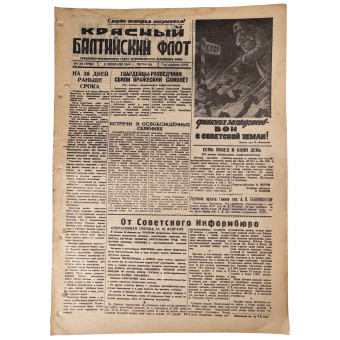
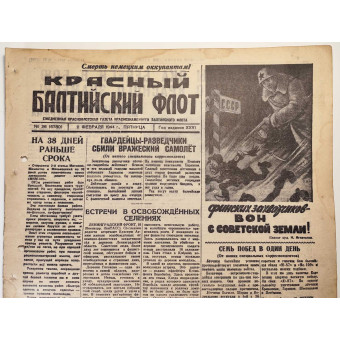
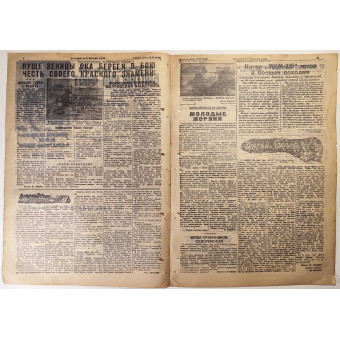
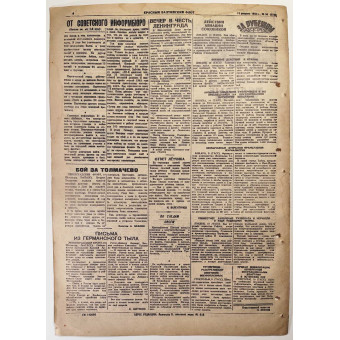
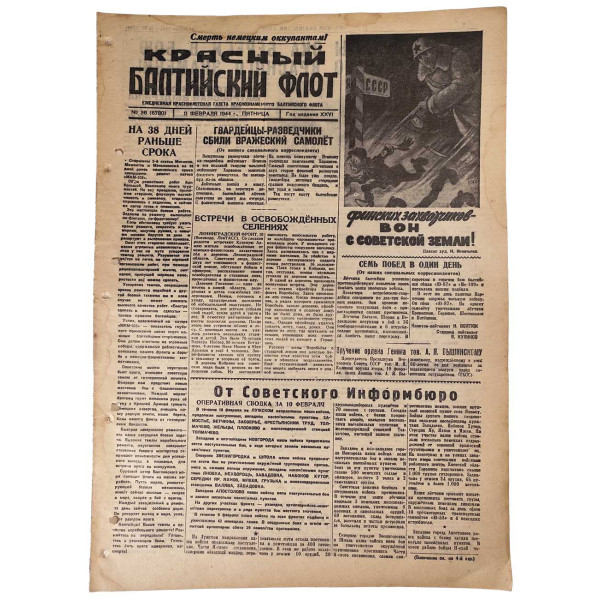
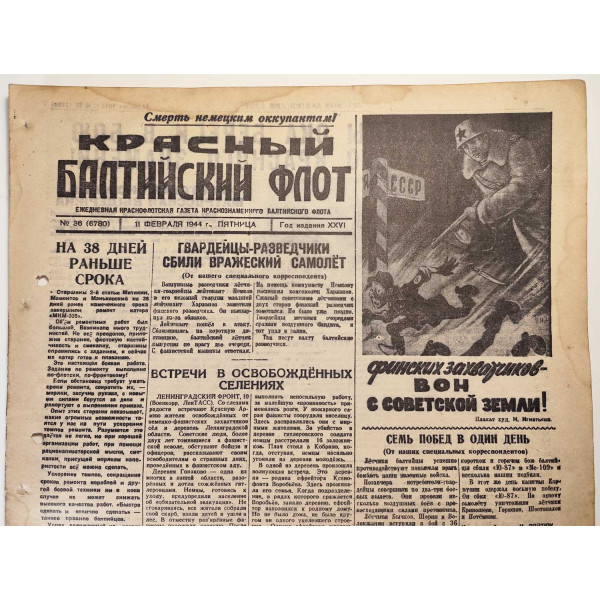
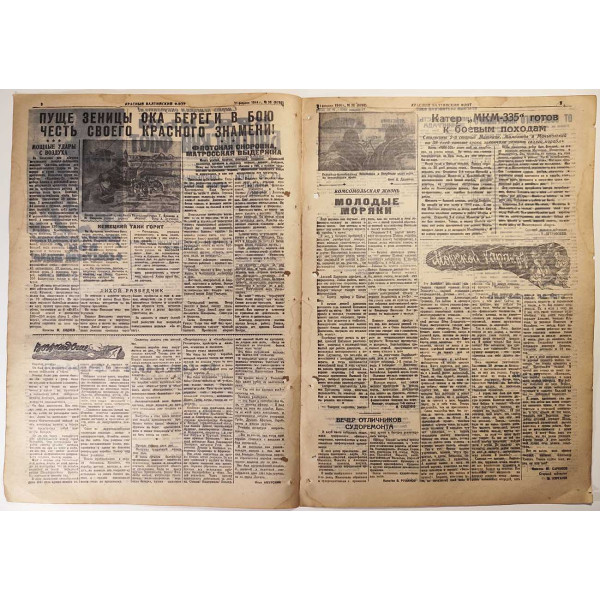
Newspaper "Red Baltic Fleet" dated February 11, 1944
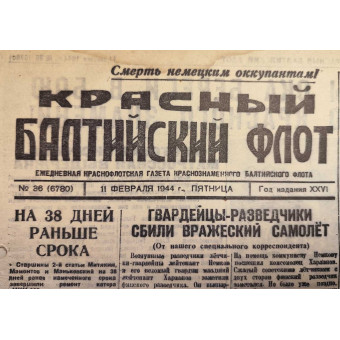
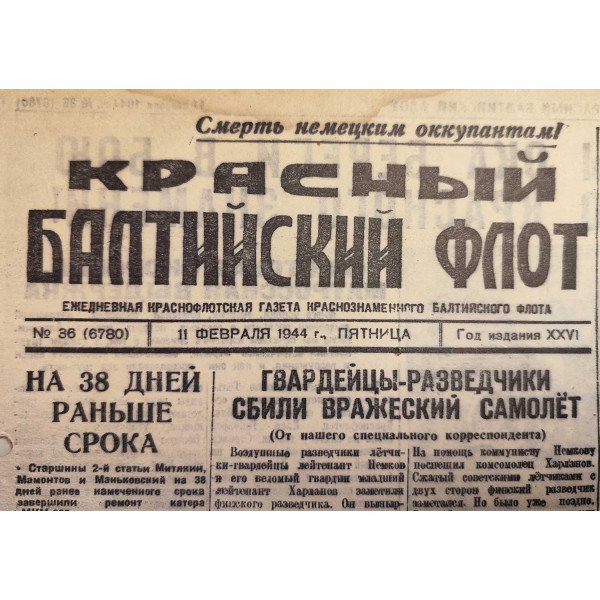
Death to the German Invaders!
RED BALTIC FLEET
Daily Red Navy newspaper of the Red Banner Baltic Fleet
No. 38 (6780) — February 11, 1944, Friday — Year XXVII
38 DAYS AHEAD OF SCHEDULE
The Mitjagin Shop, opened in May, completed the January production plan on January 10. Production work was fulfilled at 138 percent. The factory workers pledged to complete the first-quarter assignment by February 15.
Many production sections are significantly exceeding the plan. For example, in the molding shop, output in January was 1.5 times higher than in the previous month. Casters Kozhin, Sharonov, and Korneev produced over a hundred complex parts — bushings, gears, and casings.
Particularly distinguished were the workers of the bolt-holding section. Turners Ershov and Grigoryev, millers Tyurin and Martynov, driller Yakovlev, and grinder Voronin — each fulfilled one and a half or more monthly quotas.
The first-quarter plan, adopted by the factory’s workforce, was approved by the director and trade union committee. It provides for a significant increase in all types of work.
Timely delivery of materials and a rational work schedule enabled the shop to maintain steady production and fulfill tasks ahead of schedule.
GUARDS RECONNAISSANCE PILOTS SHOOT DOWN ENEMY PLANE
(From our special correspondent)
An aerial reconnaissance unit of one of the Guards formations of the Red Banner Baltic Fleet was assigned to locate a vital target on enemy territory. The mission was carried out under difficult weather conditions — snow, wind, and clouds.
Guards Lieutenants Kashtanov and Kapustin flew the reconnaissance mission. They located and photographed the target, and then turned back to base. Soon, however, they were attacked by a Focke-Wulf fighter.
Kashtanov engaged the enemy. In the decisive phase of the battle, the Soviet plane gained a favorable position. The enemy tried to escape, but was overtaken. A cannon burst — and the fascist aircraft caught fire and crashed.
The crew returned safely. For their courage and skillful actions, the pilots were recommended for government awards.
ENCOUNTERS IN LIBERATED VILLAGES
LENINGRAD FRONT, February 10 (War Correspondent, LentASS). With tears of joy, residents of villages and settlements in the Leningrad region, recently liberated from German-Finnish occupiers, welcomed the Red Army. Soviet people, who had suffered under fascist captivity for over two years, gathered around the soldiers and officers, sharing stories of horror.
The village of Gomalovo is one of many completely destroyed and burned by the Germans. Preparing to retreat, they ordered a “mandatory evacuation.” One night, residents gathered in the club with their children and moved toward the designated area. The children were laid on the ground. Then came the command: “Lie facing the sun, don’t move!” — followed by automatic gunfire. Among the murdered were 70-year-old Lisovsky, 80-year-old Bogach Arhipovna, and ten others. Women were also brutally killed. The atrocities in Kobrino and Tolmachevo were even worse.
In Kobrino, people were beaten in turns on the firehouse tower. They were forced to do unbearable labor. For the slightest “offense,” they were ordered to dig trenches. The Nazis built a gallows beside the fire shed.
The Germans executed civilians. For one killed German soldier, they shot 16 hostages. As they retreated, they abducted the village youth.
Vorobyevo — a village just a mile away — was where the fascist sergeant Képpen (nicknamed Vorobyev) was killed. It housed around 70 families. When German troops arrived, they burned every home.
In one house, the Nazis burned alive 36 women and children.
Other villages experienced similar horrors.
Russian peasants survived the brutal winter nights by burning hut after hut for warmth. They ate frozen potatoes and candies, drank melted snow. But they believed in liberation — believed in the Red Army soldier and in their Motherland.
SEVEN VICTORIES IN ONE DAY
(From our special correspondents)
The pilots of the Baltic Fleet effectively counteracted the enemy’s attempts to bomb our ground forces.
The day before yesterday, Guards fighter pilots flew two to three combat sorties each. They engaged in several aerial battles with superior enemy forces. Pilots Bychkov, Shchorin, and Kronovsky fought against six Ju-87s and Me-109s and shot down five aircraft.
That same day, Captain Kargushin scored his eighth victory by downing a Ju-87. One aircraft each was shot down by pilots Krivosheev, Goryunov, Shestakov, and Piskunov.
Captain-Lieutenant I. VOYTOK
Senior Lieutenant V. KUZIKOV
AWARDING THE ORDER OF LENIN TO COMRADE A. Y. VYSHINSKY
At the Kremlin, in the Small Hall of the Supreme Soviet of the USSR, on February 10, a ceremony was held to award the Order of Lenin to Deputy Chairman of the Council of People’s Commissars and People’s Commissar for Foreign Affairs, Comrade A. Y. Vyshinsky.
The award was presented on behalf of the Presidium of the Supreme Soviet of the USSR by its Chairman, Comrade M. I. Kalinin.
Present at the ceremony were: Deputy Chairman of the Council of People’s Commissars and Chairman of the State Planning Committee Comrade N. A. Voznesensky; Deputy Commissar for Foreign Affairs Comrade L. M. Karakhan; Head of the First Department of the Foreign Commissariat Comrade A. Y. Bogomolov; Head of the Consular Department Comrade A. A. Groshevoy; Head of the Legal Department Comrade I. T. Tarasov, and other Foreign Commissariat officials.
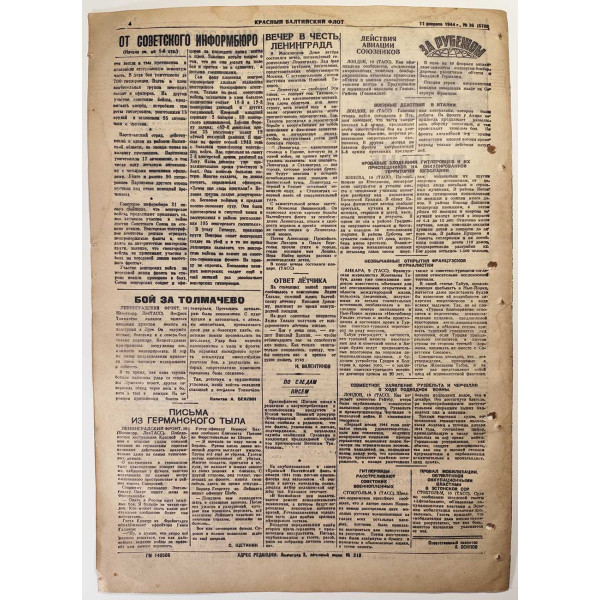
FROM THE SOVIET INFORMATION BUREAU
Operational Summary for February 10
On February 10, on the Luga front, our forces continued their offensive and captured the settlements of Zamostye, Beguny, Zaozerye, Krestyansky Trud, Tolmachevo, Zheltsy, Plyukhovo, and the railway station of Tolmachevo.
West and southwest of Novgorod, Soviet troops continued offensive battles and occupied several settlements.
North of Zvenigorodka and Shpola, our forces continued operations to eliminate an encircled enemy group, tightening the ring and capturing the villages of Yanovka, Nekorovka, Zavadovka, Nabokov Khutor, Seredin Yar, Yakhnov, Mleev, Gruzka, and the railway stations of Valyava and Zavadovka.
West of Apostolovo, our forces advanced and captured several populated areas.
In other sectors of the front, reconnaissance units, artillery, and mortars exchanged fire and conducted local engagements.
Over the course of the day, Soviet forces destroyed 43 German tanks. In aerial combat and with anti-aircraft fire, 29 enemy aircraft were shot down.
Troops of the 2nd Shock Corps, executing a flanking maneuver, intercepted the enemy’s withdrawal route, destroying 100 German soldiers, capturing 10 artillery pieces and 70 supply wagons, and seizing the station of Tolmachevo.
West of Novgorod, over 500 German soldiers were killed in battle. Three tanks and two self-propelled guns were destroyed. Soviet forces captured Yanovka, Zavadovka, Seredin Yar, Yakhnov, and other settlements. In total, up to 1,000 German troops were killed, and 24 guns, 65 machine guns, and over 1,000 vehicles were seized.
Soviet pilots shot down 10 Ju-52 transport planes and 4 German fighters in one day.
Tank units entered the enemy’s rear and attacked retreating German forces. During the battle, up to 700 Germans were killed. A significant number of enemy soldiers and officers were taken prisoner. Elsewhere, Soviet troops broke through and encountered a German convoy, destroying 15 guns with tractors and 95 supply trucks.
A partisan detachment operating in Vinnytsia region ambushed an enemy column. The partisans destroyed 17 vehicles, including a passenger car carrying four German officers. Around 90 German soldiers were killed or wounded. The partisans also derailed a German armored train.
On January 31, the Soviet Information Bureau reported that the settlement of Tarnopol had been liberated. Updated reports confirm that on February 4, Red Army units captured the regional center — the city of Tarnopol. Up to 1,200 German troops were killed in the fighting.
Soviet forces encountered fierce resistance in battles with Hungarian units. In several areas, our troops stormed fortified positions and drove out the Hungarians.
A partisan group entered one village and captured an entire Hungarian company. Among the prisoners were officers and soldiers — many admitted it was their first and likely last combat experience. A large number of rifles, machine guns, grenades, and ammunition were seized.
The appearance of a Hungarian general in the combat zone caused great unrest among the captured Hungarians. Recently, Soviet artillery destroyed 18 and 19 German tanks in this area. Our cavalry captured over 300 enemy soldiers and officers.
On January 31, in a region near Leningrad, a Ju-52 German transport aircraft was shot down. Soviet pilots also destroyed two German fighters.
105 Hungarian field kitchen personnel captured near Glinyany confessed that they had gone two days without food or water and that 70 percent of them were suffering from dysentery. A captured Hungarian lieutenant stated:
“We were sent here like meat for slaughter. We don’t even know what we’re fighting for.”
Soviet reconnaissance discovered a large radio station used by Hungarian officers to communicate with their command. It was seized without a single shot.
GERMAN TROOPS EXECUTE SOVIET PRISONERS
STOCKHOLM, Feb. 9 (TASS). The Swedish-Norwegian press bureau reports that near Narvik, German forces executed two young Soviet POWs in front of the entire camp. All the other prisoners were forced to watch. The bodies were wrapped in paper, placed in ordinary boxes, and buried.
OCCUPATION AUTHORITIES FAIL TO MOBILIZE IN ESTONIA
STOCKHOLM, Feb. 10 (TASS). According to the Swedish newspaper Aftonbladet, the draft declared by occupation authorities in Estonia has failed. The paper acknowledges that “the results of the mobilization were very modest” as most of the population avoided it.
LETTERS FROM BEHIND GERMAN LINES
LENINGRAD FRONT, Feb. 10 (War correspondent, LentASS). The victorious advance of the Red Army and powerful Allied bombing of German cities are shaking even the most thick-headed Germans.
Letters found on dead enemy soldiers in cleared areas south of Siversky reveal their inner mood.
Grenadier Engelhardt’s wife from Frauendorf writes:
“Again, heavy fighting in Russia. I no longer read the reports. Who knows what awful news will be printed next…”
Heinrich Krüger from Freital writes to Corporal Hans Gläser:
“Well, I think everything will soon come to a head, because continuing this war won’t bring us anything good.”
To Unteroffizier Werner Bachmann, Elisabeth Prill from Fürstenwalde an der Spree reports:
“I went to Berlin for a few hours. The ruins along the rail line are terrible. Corpses haven’t even been cleared. Newspapers are full of death notices. Many soldiers returning on leave find none of their family alive. Others who died at the front met their end while on leave…”
Werner, writing to Officer Schiebe from Leipzig, says:
“We are gradually beginning to live in terrifying times. After the horrors and destruction we've already endured, the entire population of Leipzig is gripped by a panic that feels like illness…”
This is how the Fritz now speaks. Their reckoning lies ahead.
S. SHCHETININ
THE BATTLE FOR TOLMACHEVO
LENINGRAD FRONT, Feb. 10 (War correspondent, LentASS). The town of Tolmachevo was a major German stronghold near Luga. It was surrounded by forests and swamps and heavily fortified from the north. Impassable terrain made maneuvering difficult. Still, our units broke through, displaying courage and valor.
While one group of fighters attacked from the Luga highway, another bypassed through woods and swamps to strike from the rear. Over vast distances, the troops advanced without rest. Artillery could not be brought in. Armed only with machine guns, submachine guns, and light mortars, the soldiers pushed forward, often waist-deep in bogs. The attack came simultaneously from front and rear.
Fierce street fighting broke out on the town’s outskirts. The German garrison was crushed.
Thus, in the most difficult conditions, our forces captured the station and town of Tolmachevo.
Captain A. BELYAIN
MILITARY OPERATIONS IN ITALY
LONDON, Feb. 10 (TASS). Allied High Command in Italy reports that American 5th Army units continue intense fighting in the Cassino area, encountering fierce resistance from the enemy. Elsewhere along the 5th Army's main front, the Germans launched counterattacks that were repelled. On the Anzio front, the enemy continues to press against Allied defenses, resulting in heavy combat. Along the 8th British Army front, poor weather limited operations to patrol actions.
BLOODY ATROCITIES OF THE NAZIS AND THEIR COLLABORATORS IN OCCUPIED YUGOSLAVIA
GENEVA, Feb. 10 (TASS). Reports from Yugoslavia reveal that Nazi occupiers, alongside Ustasha and Chetnik collaborators, carried out massacres of civilians in the Bosanska Krajina region. In villages such as Kovar, fascist criminals looted peasants, burned homes, stole livestock, and wiped out entire families — men, women, children, and the elderly. In one village near Gradiska, 30 women and children were burned alive by the occupiers.
In the Dubovac area, about 1,200 people were rounded up and subjected to torture so brutal that many died from the agony. In the Kostajnica region, women were dragged from besieged houses and killed. In the Novska area, young girls were abducted, murdered, and thrown into mass graves alongside children and women.
There are numerous documented cases where entire villages were slaughtered — down to infants. In the Kuterovo region, German and Ustasha bands destroyed 110 homes in just two days. The estimated number of victims in these areas is around 1,500.
JOINT STATEMENT BY ROOSEVELT AND CHURCHILL ON THE SUBMARINE WAR
LONDON, Feb. 10 (TASS). According to Reuters, a joint statement by President Roosevelt and Prime Minister Churchill regarding the submarine war was released yesterday. The communiqué reads:
“The first month of 1944 was very satisfactory for the Allies in their continued campaign against German submarines. Despite limited opportunities to attack — as the enemy is now extremely cautious — more submarines were destroyed in January than in December. This was achieved through relentless offensive actions by our surface fleets and air forces.
The tonnage of merchant ships sunk by German submarines in January 1944 was among the lowest in the entire war. German claims, as usual, should be disregarded, as they are highly exaggerated and published solely for propaganda purposes.”
Description
Death to the German Invaders!
RED BALTIC FLEET
Daily Red Navy newspaper of the Red Banner Baltic Fleet
No. 38 (6780) — February 11, 1944, Friday — Year XXVII
38 DAYS AHEAD OF SCHEDULE
The Mitjagin Shop, opened in May, completed the January production plan on January 10. Production work was fulfilled at 138 percent. The factory workers pledged to complete the first-quarter assignment by February 15.
Many production sections are significantly exceeding the plan. For example, in the molding shop, output in January was 1.5 times higher than in the previous month. Casters Kozhin, Sharonov, and Korneev produced over a hundred complex parts — bushings, gears, and casings.
Particularly distinguished were the workers of the bolt-holding section. Turners Ershov and Grigoryev, millers Tyurin and Martynov, driller Yakovlev, and grinder Voronin — each fulfilled one and a half or more monthly quotas.
The first-quarter plan, adopted by the factory’s workforce, was approved by the director and trade union committee. It provides for a significant increase in all types of work.
Timely delivery of materials and a rational work schedule enabled the shop to maintain steady production and fulfill tasks ahead of schedule.
GUARDS RECONNAISSANCE PILOTS SHOOT DOWN ENEMY PLANE
(From our special correspondent)
An aerial reconnaissance unit of one of the Guards formations of the Red Banner Baltic Fleet was assigned to locate a vital target on enemy territory. The mission was carried out under difficult weather conditions — snow, wind, and clouds.
Guards Lieutenants Kashtanov and Kapustin flew the reconnaissance mission. They located and photographed the target, and then turned back to base. Soon, however, they were attacked by a Focke-Wulf fighter.
Kashtanov engaged the enemy. In the decisive phase of the battle, the Soviet plane gained a favorable position. The enemy tried to escape, but was overtaken. A cannon burst — and the fascist aircraft caught fire and crashed.
The crew returned safely. For their courage and skillful actions, the pilots were recommended for government awards.
ENCOUNTERS IN LIBERATED VILLAGES
LENINGRAD FRONT, February 10 (War Correspondent, LentASS). With tears of joy, residents of villages and settlements in the Leningrad region, recently liberated from German-Finnish occupiers, welcomed the Red Army. Soviet people, who had suffered under fascist captivity for over two years, gathered around the soldiers and officers, sharing stories of horror.
The village of Gomalovo is one of many completely destroyed and burned by the Germans. Preparing to retreat, they ordered a “mandatory evacuation.” One night, residents gathered in the club with their children and moved toward the designated area. The children were laid on the ground. Then came the command: “Lie facing the sun, don’t move!” — followed by automatic gunfire. Among the murdered were 70-year-old Lisovsky, 80-year-old Bogach Arhipovna, and ten others. Women were also brutally killed. The atrocities in Kobrino and Tolmachevo were even worse.
In Kobrino, people were beaten in turns on the firehouse tower. They were forced to do unbearable labor. For the slightest “offense,” they were ordered to dig trenches. The Nazis built a gallows beside the fire shed.
The Germans executed civilians. For one killed German soldier, they shot 16 hostages. As they retreated, they abducted the village youth.
Vorobyevo — a village just a mile away — was where the fascist sergeant Képpen (nicknamed Vorobyev) was killed. It housed around 70 families. When German troops arrived, they burned every home.
In one house, the Nazis burned alive 36 women and children.
Other villages experienced similar horrors.
Russian peasants survived the brutal winter nights by burning hut after hut for warmth. They ate frozen potatoes and candies, drank melted snow. But they believed in liberation — believed in the Red Army soldier and in their Motherland.
SEVEN VICTORIES IN ONE DAY
(From our special correspondents)
The pilots of the Baltic Fleet effectively counteracted the enemy’s attempts to bomb our ground forces.
The day before yesterday, Guards fighter pilots flew two to three combat sorties each. They engaged in several aerial battles with superior enemy forces. Pilots Bychkov, Shchorin, and Kronovsky fought against six Ju-87s and Me-109s and shot down five aircraft.
That same day, Captain Kargushin scored his eighth victory by downing a Ju-87. One aircraft each was shot down by pilots Krivosheev, Goryunov, Shestakov, and Piskunov.
Captain-Lieutenant I. VOYTOK
Senior Lieutenant V. KUZIKOV
AWARDING THE ORDER OF LENIN TO COMRADE A. Y. VYSHINSKY
At the Kremlin, in the Small Hall of the Supreme Soviet of the USSR, on February 10, a ceremony was held to award the Order of Lenin to Deputy Chairman of the Council of People’s Commissars and People’s Commissar for Foreign Affairs, Comrade A. Y. Vyshinsky.
The award was presented on behalf of the Presidium of the Supreme Soviet of the USSR by its Chairman, Comrade M. I. Kalinin.
Present at the ceremony were: Deputy Chairman of the Council of People’s Commissars and Chairman of the State Planning Committee Comrade N. A. Voznesensky; Deputy Commissar for Foreign Affairs Comrade L. M. Karakhan; Head of the First Department of the Foreign Commissariat Comrade A. Y. Bogomolov; Head of the Consular Department Comrade A. A. Groshevoy; Head of the Legal Department Comrade I. T. Tarasov, and other Foreign Commissariat officials.
FROM THE SOVIET INFORMATION BUREAU
Operational Summary for February 10
On February 10, on the Luga front, our forces continued their offensive and captured the settlements of Zamostye, Beguny, Zaozerye, Krestyansky Trud, Tolmachevo, Zheltsy, Plyukhovo, and the railway station of Tolmachevo.
West and southwest of Novgorod, Soviet troops continued offensive battles and occupied several settlements.
North of Zvenigorodka and Shpola, our forces continued operations to eliminate an encircled enemy group, tightening the ring and capturing the villages of Yanovka, Nekorovka, Zavadovka, Nabokov Khutor, Seredin Yar, Yakhnov, Mleev, Gruzka, and the railway stations of Valyava and Zavadovka.
West of Apostolovo, our forces advanced and captured several populated areas.
In other sectors of the front, reconnaissance units, artillery, and mortars exchanged fire and conducted local engagements.
Over the course of the day, Soviet forces destroyed 43 German tanks. In aerial combat and with anti-aircraft fire, 29 enemy aircraft were shot down.
Troops of the 2nd Shock Corps, executing a flanking maneuver, intercepted the enemy’s withdrawal route, destroying 100 German soldiers, capturing 10 artillery pieces and 70 supply wagons, and seizing the station of Tolmachevo.
West of Novgorod, over 500 German soldiers were killed in battle. Three tanks and two self-propelled guns were destroyed. Soviet forces captured Yanovka, Zavadovka, Seredin Yar, Yakhnov, and other settlements. In total, up to 1,000 German troops were killed, and 24 guns, 65 machine guns, and over 1,000 vehicles were seized.
Soviet pilots shot down 10 Ju-52 transport planes and 4 German fighters in one day.
Tank units entered the enemy’s rear and attacked retreating German forces. During the battle, up to 700 Germans were killed. A significant number of enemy soldiers and officers were taken prisoner. Elsewhere, Soviet troops broke through and encountered a German convoy, destroying 15 guns with tractors and 95 supply trucks.
A partisan detachment operating in Vinnytsia region ambushed an enemy column. The partisans destroyed 17 vehicles, including a passenger car carrying four German officers. Around 90 German soldiers were killed or wounded. The partisans also derailed a German armored train.
On January 31, the Soviet Information Bureau reported that the settlement of Tarnopol had been liberated. Updated reports confirm that on February 4, Red Army units captured the regional center — the city of Tarnopol. Up to 1,200 German troops were killed in the fighting.
Soviet forces encountered fierce resistance in battles with Hungarian units. In several areas, our troops stormed fortified positions and drove out the Hungarians.
A partisan group entered one village and captured an entire Hungarian company. Among the prisoners were officers and soldiers — many admitted it was their first and likely last combat experience. A large number of rifles, machine guns, grenades, and ammunition were seized.
The appearance of a Hungarian general in the combat zone caused great unrest among the captured Hungarians. Recently, Soviet artillery destroyed 18 and 19 German tanks in this area. Our cavalry captured over 300 enemy soldiers and officers.
On January 31, in a region near Leningrad, a Ju-52 German transport aircraft was shot down. Soviet pilots also destroyed two German fighters.
105 Hungarian field kitchen personnel captured near Glinyany confessed that they had gone two days without food or water and that 70 percent of them were suffering from dysentery. A captured Hungarian lieutenant stated:
“We were sent here like meat for slaughter. We don’t even know what we’re fighting for.”
Soviet reconnaissance discovered a large radio station used by Hungarian officers to communicate with their command. It was seized without a single shot.
GERMAN TROOPS EXECUTE SOVIET PRISONERS
STOCKHOLM, Feb. 9 (TASS). The Swedish-Norwegian press bureau reports that near Narvik, German forces executed two young Soviet POWs in front of the entire camp. All the other prisoners were forced to watch. The bodies were wrapped in paper, placed in ordinary boxes, and buried.
OCCUPATION AUTHORITIES FAIL TO MOBILIZE IN ESTONIA
STOCKHOLM, Feb. 10 (TASS). According to the Swedish newspaper Aftonbladet, the draft declared by occupation authorities in Estonia has failed. The paper acknowledges that “the results of the mobilization were very modest” as most of the population avoided it.
LETTERS FROM BEHIND GERMAN LINES
LENINGRAD FRONT, Feb. 10 (War correspondent, LentASS). The victorious advance of the Red Army and powerful Allied bombing of German cities are shaking even the most thick-headed Germans.
Letters found on dead enemy soldiers in cleared areas south of Siversky reveal their inner mood.
Grenadier Engelhardt’s wife from Frauendorf writes:
“Again, heavy fighting in Russia. I no longer read the reports. Who knows what awful news will be printed next…”
Heinrich Krüger from Freital writes to Corporal Hans Gläser:
“Well, I think everything will soon come to a head, because continuing this war won’t bring us anything good.”
To Unteroffizier Werner Bachmann, Elisabeth Prill from Fürstenwalde an der Spree reports:
“I went to Berlin for a few hours. The ruins along the rail line are terrible. Corpses haven’t even been cleared. Newspapers are full of death notices. Many soldiers returning on leave find none of their family alive. Others who died at the front met their end while on leave…”
Werner, writing to Officer Schiebe from Leipzig, says:
“We are gradually beginning to live in terrifying times. After the horrors and destruction we've already endured, the entire population of Leipzig is gripped by a panic that feels like illness…”
This is how the Fritz now speaks. Their reckoning lies ahead.
S. SHCHETININ
THE BATTLE FOR TOLMACHEVO
LENINGRAD FRONT, Feb. 10 (War correspondent, LentASS). The town of Tolmachevo was a major German stronghold near Luga. It was surrounded by forests and swamps and heavily fortified from the north. Impassable terrain made maneuvering difficult. Still, our units broke through, displaying courage and valor.
While one group of fighters attacked from the Luga highway, another bypassed through woods and swamps to strike from the rear. Over vast distances, the troops advanced without rest. Artillery could not be brought in. Armed only with machine guns, submachine guns, and light mortars, the soldiers pushed forward, often waist-deep in bogs. The attack came simultaneously from front and rear.
Fierce street fighting broke out on the town’s outskirts. The German garrison was crushed.
Thus, in the most difficult conditions, our forces captured the station and town of Tolmachevo.
Captain A. BELYAIN
MILITARY OPERATIONS IN ITALY
LONDON, Feb. 10 (TASS). Allied High Command in Italy reports that American 5th Army units continue intense fighting in the Cassino area, encountering fierce resistance from the enemy. Elsewhere along the 5th Army's main front, the Germans launched counterattacks that were repelled. On the Anzio front, the enemy continues to press against Allied defenses, resulting in heavy combat. Along the 8th British Army front, poor weather limited operations to patrol actions.
BLOODY ATROCITIES OF THE NAZIS AND THEIR COLLABORATORS IN OCCUPIED YUGOSLAVIA
GENEVA, Feb. 10 (TASS). Reports from Yugoslavia reveal that Nazi occupiers, alongside Ustasha and Chetnik collaborators, carried out massacres of civilians in the Bosanska Krajina region. In villages such as Kovar, fascist criminals looted peasants, burned homes, stole livestock, and wiped out entire families — men, women, children, and the elderly. In one village near Gradiska, 30 women and children were burned alive by the occupiers.
In the Dubovac area, about 1,200 people were rounded up and subjected to torture so brutal that many died from the agony. In the Kostajnica region, women were dragged from besieged houses and killed. In the Novska area, young girls were abducted, murdered, and thrown into mass graves alongside children and women.
There are numerous documented cases where entire villages were slaughtered — down to infants. In the Kuterovo region, German and Ustasha bands destroyed 110 homes in just two days. The estimated number of victims in these areas is around 1,500.
JOINT STATEMENT BY ROOSEVELT AND CHURCHILL ON THE SUBMARINE WAR
LONDON, Feb. 10 (TASS). According to Reuters, a joint statement by President Roosevelt and Prime Minister Churchill regarding the submarine war was released yesterday. The communiqué reads:
“The first month of 1944 was very satisfactory for the Allies in their continued campaign against German submarines. Despite limited opportunities to attack — as the enemy is now extremely cautious — more submarines were destroyed in January than in December. This was achieved through relentless offensive actions by our surface fleets and air forces.
The tonnage of merchant ships sunk by German submarines in January 1944 was among the lowest in the entire war. German claims, as usual, should be disregarded, as they are highly exaggerated and published solely for propaganda purposes.”
Payment & Delivery