Your shopping cart is empty!
« back
« back
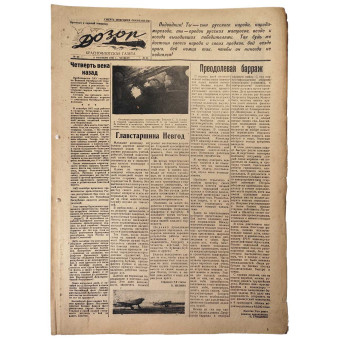
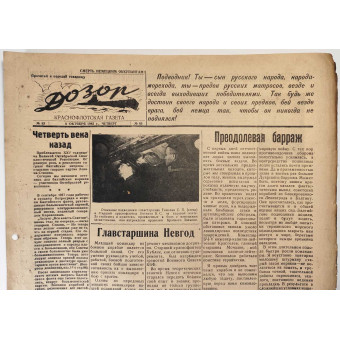
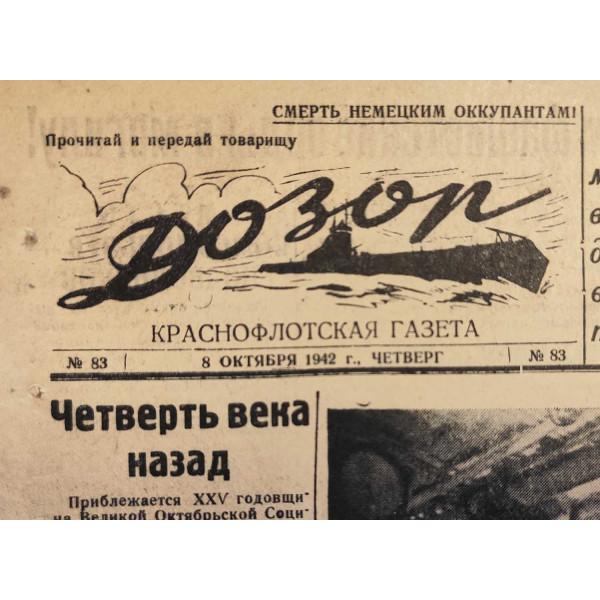
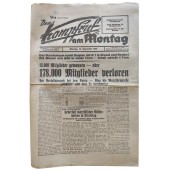
Newspaper of the Soviet Navy "Dozor", October 8, 1942
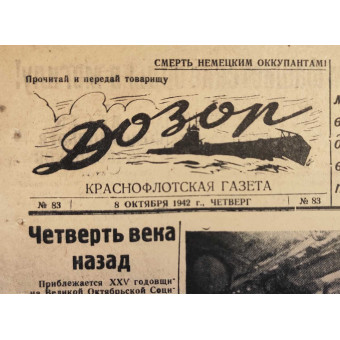
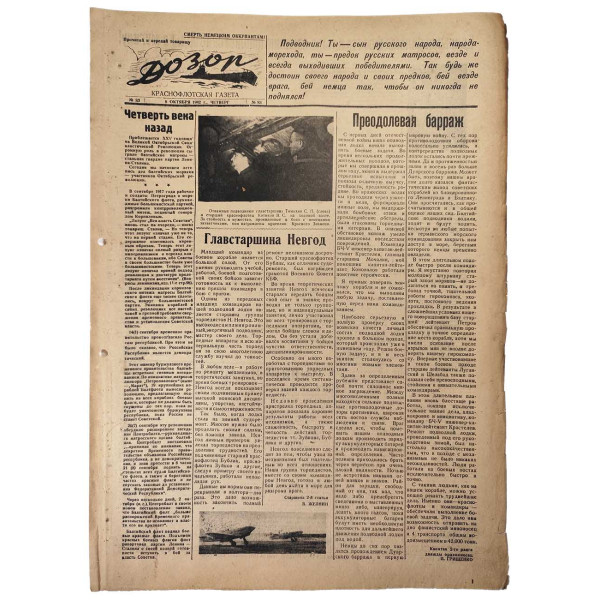
Submariners’ Newspaper Dozor No. 83
October 8, 1942, Thursday
An extremely rare copy preserved in a single instance. The newspaper comes from a museum collection, where it was transferred from the archive of the printing house.
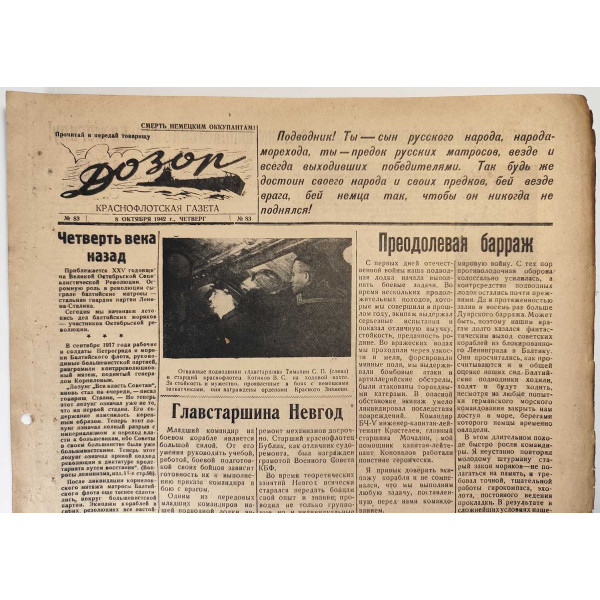
DOZOR
Red Navy newspaper
October 8, 1942, Thursday
No. 83
Death to the German occupiers!
Read and pass to a comrade.
Submariner! You are the son of the Russian people, the seafaring nation, the descendant of Russian sailors who always and everywhere emerged victorious. Be worthy of your people and your ancestors, strike the enemy everywhere, strike the German so that he never rises again!
A quarter of a century ago
The 25th anniversary of the Great October Socialist Revolution is approaching. The Baltic sailors — the steel guard of the Lenin–Stalin party — played a tremendous role in the revolution.
Today we begin the chronicle of the deeds of Baltic sailors — participants of the October Revolution.
In September 1917 the workers and soldiers of Petrograd and the sailors of the Baltic Fleet, guided by the Bolshevik Party, energetically supported the slogan “All power to the Soviets!” and moved to storm the power of the capitalists and landlords.
On September 14 (27), the Provisional Government capitulated before the power of the masses and was forced to create the so-called “directory government.”
This maneuver of the bourgeoisie did not stop the working class. Under the leadership of the Bolshevik Party, the struggle continued. Broad masses rallied around the Bolsheviks.
The Kornilov revolt and its defeat further undermined the authority of the Provisional Government. The further sharpening of the crisis led to open struggle for power.
On October 25 (November 7), 1917, the Soviets, under the leadership of the Bolshevik Party, overthrew the power of the capitalists. Throughout the entire struggle for Soviet power, the leading role belonged to the workers and sailors.
It was the sailors of the Baltic Fleet who first raised their weapons in defense of the achievements of the revolution.
Chief Petty Officer Nevgod
A junior commander on a warship is a great force. The success of battle largely depends on his skillful leadership in training, combat preparation, and conduct in battle.
There are many junior commanders on warships. Each commander must care about educating his subordinates in the spirit of selfless devotion to the Motherland.
A vivid example is Chief Petty Officer of the torpedo group Nevgod. This energetic and conscientious warrior leads his men to the heights of mastery.
Nevgod skillfully organizes the combat training of the torpedo men, works hard himself, and shares his experience. Under his leadership, Red Navy sailors Bublik, Zubkov, and others quickly mastered the complex equipment, learned to disassemble and repair mechanisms.
Red Navy sailor Bublik, as an excellent ship repairman, was awarded by decision of the Military Council of the Baltic Fleet.
During battle alerts, Chief Petty Officer Nevgod is always ahead of his comrades. He personally participates in all drills, demanding flawless precision and discipline from his subordinates.
He conducts the preparation of torpedo tubes for firing especially skillfully. The results of training launches testify to the knowledge of every torpedo man.
In a recent combat mission, the torpedo crew showed excellent results: the tubes worked flawlessly, and the quick and accurate hits ensured the success of the attack.
Nevgod honors the high title of a naval warrior and fully justifies the trust of the command.
Overcoming the barrage
From the first days of the Patriotic War our submarine began to fulfill combat tasks.
During several long voyages the submariners boldly penetrated into areas where the enemy had established continuous artillery and mine barrages.
Enemy forces constantly guarded these parts of the sea, laying mines, conducting intense artillery fire, and sending submarine hunters and patrol boats.
In these dangerous conditions the submariners showed examples of courage and endurance.
The submarine’s commander, Captain Krasnetsov, and his executive officer Malinin skillfully navigated the ship through the barrages.
The crew showed marvels of restraint, discipline, and organization. As a result, all missions assigned by command were completed.
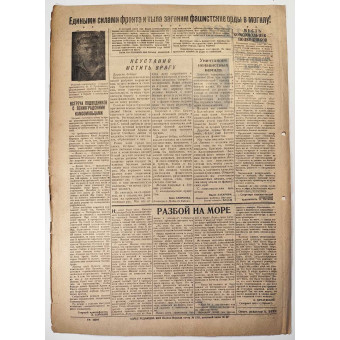
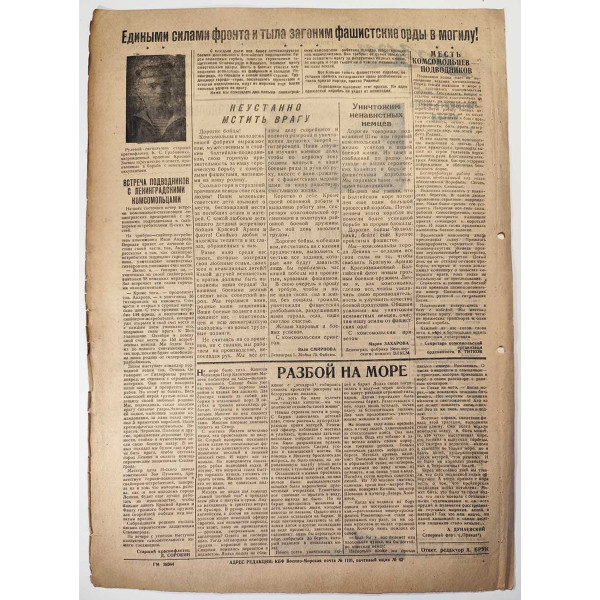
With united strength of front and rear we shall drive the fascist hordes into their grave!
Meeting of submariners with Leningrad Komsomol members
We have had many meetings with the Komsomol youth of Leningrad. But the meeting of submariners with Leningrad Komsomol members will remain especially memorable.
“Dear comrades!” said the secretary of the district committee of the Komsomol. “We have come to you to present our gift.”
Then Red Navy sailor Sorokin spoke. He told about the combat exploits of his submarine, how his comrades sink enemy ships. He described daring attacks and the endurance of the crew.
Sorokin’s speech was met with stormy applause.
Vengeance without rest against the enemy
Dear fighters!
The Komsomol members and youth of Leningrad warmly greet you and send you their combat salute.
With each passing day the struggle with the hated enemy grows fiercer. Our youth spares no effort to strike the invaders even harder.
We will avenge the destroyed houses, the blood of brothers and sisters, the abuse of the elderly, the fallen comrades.
Can we forget the atrocities of the Germans in our villages? Can we forgive them the blood of children and women? No!
We will take revenge to the end, until the last fascist on our land is destroyed.
Destroy the hated Germans
Dear comrades submariners!
We, the youth of Leningrad, see your combat successes and warmly greet you.
Every one of your voyages, every torpedo launched at the enemy strengthens our confidence in victory.
The Baltic Sea resounds with your victories. Enemy ships sink one after another.
Dear comrades! We, the people of Leningrad, live under enemy fire. But like you, we swear to stand to the end.
Let the whole world know: Leningrad lives and will live!
Revenge of the Komsomol submariners
The Komsomol submariners swear to carry out combat missions with even greater energy, to strike the enemy crushing blows, to sink his ships and transports.
We avenge the destroyed cities, the spilled blood, the ravaged villages.
Every voyage is a blow against the enemy, every torpedoing is revenge for our brothers and sisters.
Piracy at sea
It is no seaman’s business to capitulate without a fight. The fascist admirals and generals who surrendered are sea robbers.
Their plunder and atrocities are known throughout the world. But now they have met the worthy response of Soviet sailors.
The sea robbers, accustomed to sinking defenseless ships, are now going to the bottom themselves.
Our submariners, our warships are smashing the enemy, and every day brings new victories.
The German sea bandits perish one after another. Their ships turn into scrap, their pride drowns in the waters of the Baltic.
And so it will always be, until the last sea pirate is destroyed!
Description
Submariners’ Newspaper Dozor No. 83
October 8, 1942, Thursday
An extremely rare copy preserved in a single instance. The newspaper comes from a museum collection, where it was transferred from the archive of the printing house.
DOZOR
Red Navy newspaper
October 8, 1942, Thursday
No. 83
Death to the German occupiers!
Read and pass to a comrade.
Submariner! You are the son of the Russian people, the seafaring nation, the descendant of Russian sailors who always and everywhere emerged victorious. Be worthy of your people and your ancestors, strike the enemy everywhere, strike the German so that he never rises again!
A quarter of a century ago
The 25th anniversary of the Great October Socialist Revolution is approaching. The Baltic sailors — the steel guard of the Lenin–Stalin party — played a tremendous role in the revolution.
Today we begin the chronicle of the deeds of Baltic sailors — participants of the October Revolution.
In September 1917 the workers and soldiers of Petrograd and the sailors of the Baltic Fleet, guided by the Bolshevik Party, energetically supported the slogan “All power to the Soviets!” and moved to storm the power of the capitalists and landlords.
On September 14 (27), the Provisional Government capitulated before the power of the masses and was forced to create the so-called “directory government.”
This maneuver of the bourgeoisie did not stop the working class. Under the leadership of the Bolshevik Party, the struggle continued. Broad masses rallied around the Bolsheviks.
The Kornilov revolt and its defeat further undermined the authority of the Provisional Government. The further sharpening of the crisis led to open struggle for power.
On October 25 (November 7), 1917, the Soviets, under the leadership of the Bolshevik Party, overthrew the power of the capitalists. Throughout the entire struggle for Soviet power, the leading role belonged to the workers and sailors.
It was the sailors of the Baltic Fleet who first raised their weapons in defense of the achievements of the revolution.
Chief Petty Officer Nevgod
A junior commander on a warship is a great force. The success of battle largely depends on his skillful leadership in training, combat preparation, and conduct in battle.
There are many junior commanders on warships. Each commander must care about educating his subordinates in the spirit of selfless devotion to the Motherland.
A vivid example is Chief Petty Officer of the torpedo group Nevgod. This energetic and conscientious warrior leads his men to the heights of mastery.
Nevgod skillfully organizes the combat training of the torpedo men, works hard himself, and shares his experience. Under his leadership, Red Navy sailors Bublik, Zubkov, and others quickly mastered the complex equipment, learned to disassemble and repair mechanisms.
Red Navy sailor Bublik, as an excellent ship repairman, was awarded by decision of the Military Council of the Baltic Fleet.
During battle alerts, Chief Petty Officer Nevgod is always ahead of his comrades. He personally participates in all drills, demanding flawless precision and discipline from his subordinates.
He conducts the preparation of torpedo tubes for firing especially skillfully. The results of training launches testify to the knowledge of every torpedo man.
In a recent combat mission, the torpedo crew showed excellent results: the tubes worked flawlessly, and the quick and accurate hits ensured the success of the attack.
Nevgod honors the high title of a naval warrior and fully justifies the trust of the command.
Overcoming the barrage
From the first days of the Patriotic War our submarine began to fulfill combat tasks.
During several long voyages the submariners boldly penetrated into areas where the enemy had established continuous artillery and mine barrages.
Enemy forces constantly guarded these parts of the sea, laying mines, conducting intense artillery fire, and sending submarine hunters and patrol boats.
In these dangerous conditions the submariners showed examples of courage and endurance.
The submarine’s commander, Captain Krasnetsov, and his executive officer Malinin skillfully navigated the ship through the barrages.
The crew showed marvels of restraint, discipline, and organization. As a result, all missions assigned by command were completed.
With united strength of front and rear we shall drive the fascist hordes into their grave!
Meeting of submariners with Leningrad Komsomol members
We have had many meetings with the Komsomol youth of Leningrad. But the meeting of submariners with Leningrad Komsomol members will remain especially memorable.
“Dear comrades!” said the secretary of the district committee of the Komsomol. “We have come to you to present our gift.”
Then Red Navy sailor Sorokin spoke. He told about the combat exploits of his submarine, how his comrades sink enemy ships. He described daring attacks and the endurance of the crew.
Sorokin’s speech was met with stormy applause.
Vengeance without rest against the enemy
Dear fighters!
The Komsomol members and youth of Leningrad warmly greet you and send you their combat salute.
With each passing day the struggle with the hated enemy grows fiercer. Our youth spares no effort to strike the invaders even harder.
We will avenge the destroyed houses, the blood of brothers and sisters, the abuse of the elderly, the fallen comrades.
Can we forget the atrocities of the Germans in our villages? Can we forgive them the blood of children and women? No!
We will take revenge to the end, until the last fascist on our land is destroyed.
Destroy the hated Germans
Dear comrades submariners!
We, the youth of Leningrad, see your combat successes and warmly greet you.
Every one of your voyages, every torpedo launched at the enemy strengthens our confidence in victory.
The Baltic Sea resounds with your victories. Enemy ships sink one after another.
Dear comrades! We, the people of Leningrad, live under enemy fire. But like you, we swear to stand to the end.
Let the whole world know: Leningrad lives and will live!
Revenge of the Komsomol submariners
The Komsomol submariners swear to carry out combat missions with even greater energy, to strike the enemy crushing blows, to sink his ships and transports.
We avenge the destroyed cities, the spilled blood, the ravaged villages.
Every voyage is a blow against the enemy, every torpedoing is revenge for our brothers and sisters.
Piracy at sea
It is no seaman’s business to capitulate without a fight. The fascist admirals and generals who surrendered are sea robbers.
Their plunder and atrocities are known throughout the world. But now they have met the worthy response of Soviet sailors.
The sea robbers, accustomed to sinking defenseless ships, are now going to the bottom themselves.
Our submariners, our warships are smashing the enemy, and every day brings new victories.
The German sea bandits perish one after another. Their ships turn into scrap, their pride drowns in the waters of the Baltic.
And so it will always be, until the last sea pirate is destroyed!
Payment & Delivery