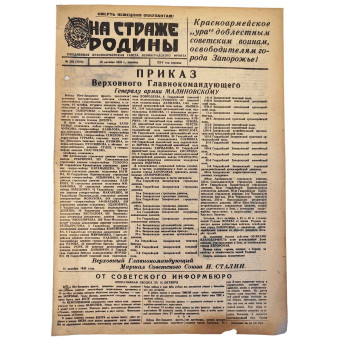
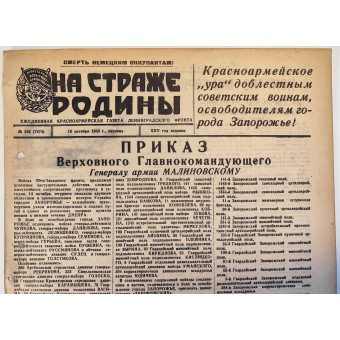
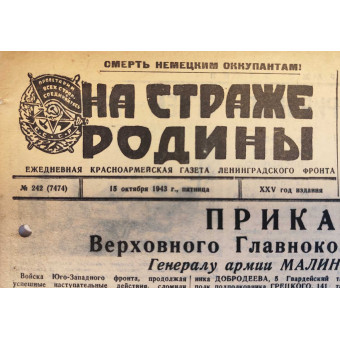
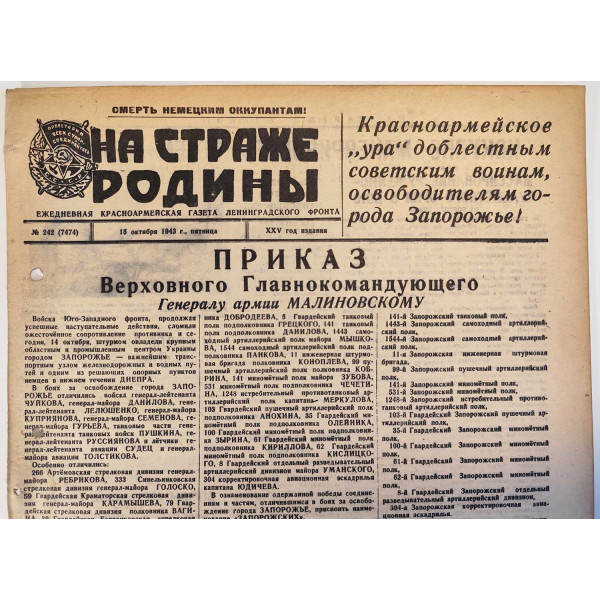
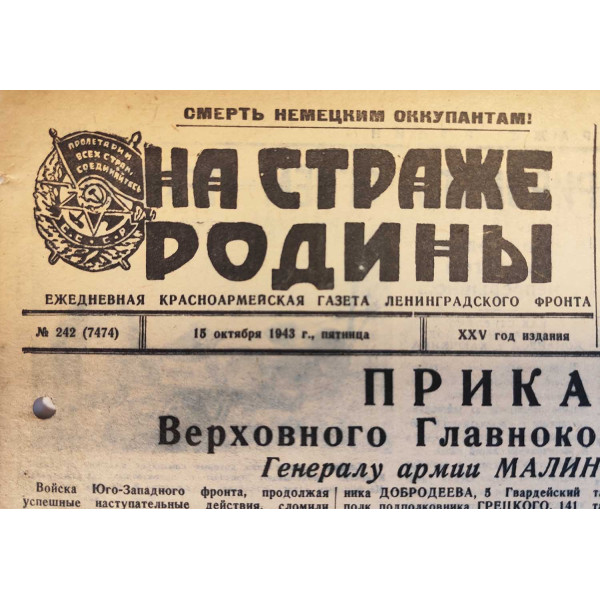
On Guard of the Motherland
Daily Red Army newspaper of the Leningrad Front
No. 242 (7474) — October 15, 1943, Friday — XXV year of publication
Death to the German occupiers!
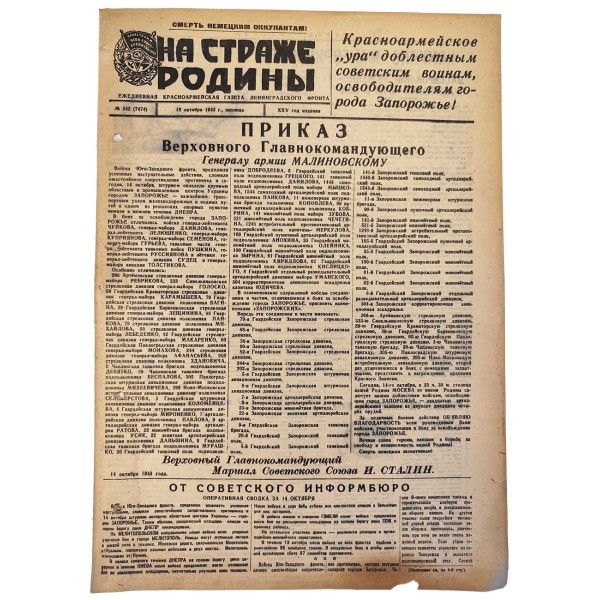
A Red Army "hurrah" to the valiant Soviet warriors, liberators of the city of Zaporozhye!
ORDER of the Supreme Commander-in-Chief
To Army General Malinovsky
The troops of the Southwestern Front, continuing their successful offensive, after fierce enemy resistance, captured the important stronghold of German defense — the city of Zaporozhye, a major transport hub and powerful fortified area of the Germans on the southern bank of the Dnieper.
In the battles for the liberation of the city of Zaporozhye the following formations and units distinguished themselves: Lieutenant General Lelyushenko, Lieutenant General Grechko, Major General Danilov, Major General Mishchenko, Major General Pankevich, the engineer assault brigade of Colonel Kolpakov, the 96th Guards Rifle Division of Major General Zubov, the 60th Guards Rifle Division of Major General Mertslov, the 203rd Guards Rifle Division of Major General Kukhin, the 333rd Rifle Division of Colonel Malyshev, the 106th Motorized Rifle Division of Colonel Vasiliev, the 100th Rifle Division of Colonel Lisin, the 302nd Rifle Division of Major General Ryabchikov, the 243rd Rifle Division of Major General Sysoev, the 152nd Rifle Division of Colonel Vishnyakov.
Particularly distinguished were:
— the 8th Guards Mechanized Corps of Lieutenant General Popov,
— the 23rd Tank Corps of Major General Kravchenko,
— the 1st Guards Mechanized Corps of Major General Solomatin,
— the 3rd Guards Mechanized Corps of Major General Lishchinsky,
— the 23rd Tank Corps of Major General Fominykh,
— the 33rd Rifle Corps of Lieutenant General Leshchinin,
— the 88th Guards Rifle Division of Major General Pankov,
— the 82nd Rifle Division of Colonel Kharitonov,
— the 59th Guards Rifle Division of Major General Monakhov,
— the 244th Rifle Division of Major General Devyatov,
— the 87th Rifle Division of Colonel Bespalov,
— the 244th Guards Rifle Regiment of Colonel Mukhvedyev,
— the 295th Novo-Moskovsky Rifle Regiment of Colonel Kolomiytsev.
Also distinguished were artillery units of: Colonel Glukhov, Colonel Gerasimov, Colonel Kablov, Colonel Usik; engineer troops of Colonel Danibin; the pontoon-bridge brigade of Colonel Muravyov; the 6th Guards Assault Aviation Division of Major General Dobrolyubov; the 8th Guards Bomber Division of Major General Grechko; the 141st Tank Brigade of Lieutenant Colonel Dayneko; the 144th Self-propelled Artillery Brigade of Major Mishukov; the 1544th Self-propelled Artillery Regiment of Lieutenant Colonel Pankov; the engineer assault brigade of Colonel Kolpakov; the 96th Guards Rifle Division of Major General Zubov; the 60th Guards Rifle Division of Major General Mertslov; the 203rd Guards Rifle Division of Major General Kukhin.
Eternal glory to the heroes who fell in battles for the freedom and independence of our Motherland!
Today, October 14, gratitude is declared to the troops who took part in the battles for the liberation of the city of Zaporozhye. In commemoration of the victory, the city of Moscow salutes the valiant troops of the Southwestern Front with twenty artillery salvoes from two hundred and twenty-four guns.
Supreme Commander-in-Chief
Marshal of the Soviet Union I. Stalin
October 14, 1943
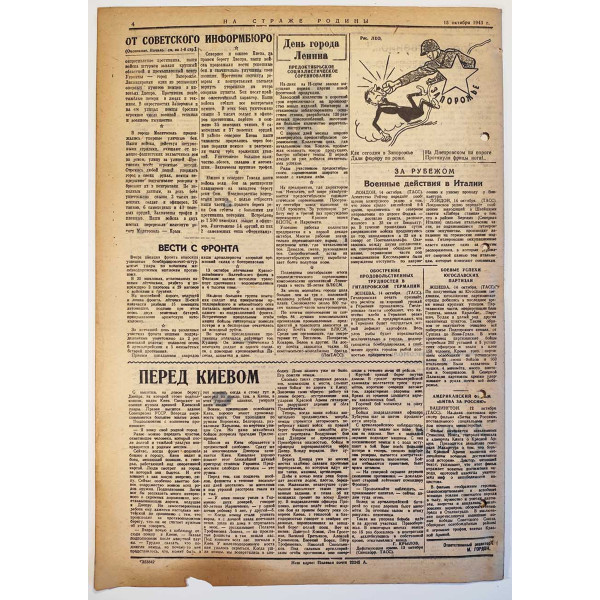
From the Soviet Information Bureau
Operational summary for October 14
On the southwestern sector our forces, overcoming stubborn enemy resistance, continued their offensive and, breaking the resistance of German troops, captured the regional center of the Ukrainian SSR — the city of Zaporozhye, an important stronghold of enemy defense and a key communications hub.
Our troops, advancing forward, occupied several dozen settlements, including major ones: Mikhailovka, Tarasovka, Novo-Nikolaevka, Balabino, Voznesenka.
On other sectors of the front — no changes.
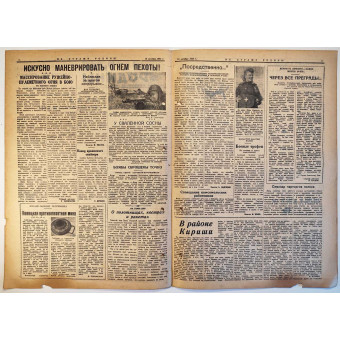
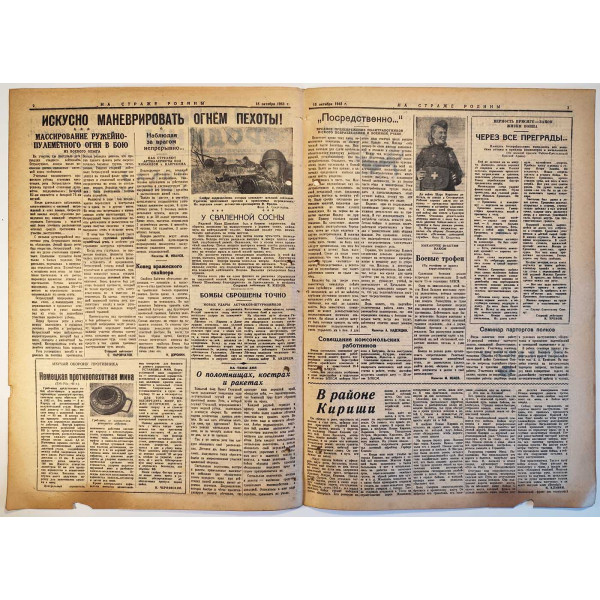
Skillfully Maneuver with Infantry Fire
When a unit advancing halts under strong enemy fire, the commander must quickly organize fire maneuver and destroy the obstructing enemy.
It is not enough just to open fire; it must be distributed so that the enemy loses the ability to aim and is forced to hide.
Machine guns and rifles should act not separately, but under the unified plan of the commander.
In battle it is especially important to quickly shift fire from one target to another, preventing the enemy from raising his head.
Fire maneuver requires the commander’s precise calculation and knowledge of terrain.
Observe the Enemy Continuously…
The enemy is cunning and deceitful. He tries to secretly move his forces, supply ammunition and weapons.
A vigilant observer will timely notice enemy movement, hear the noise of a motor, the clank of tracks, the barking of dogs, the cry of a sentry.
This must be immediately reported to the commander.
A good observer is armed with binoculars, knows landmarks, and keeps accurate notes.
Observation must continue day and night, in any weather.
At the Fallen Pine
At the forward edge, near a fallen pine, in a trench sat a scout.
The night was dark. Ahead — silence.
The scout listened to every sound, peered into the darkness.
Suddenly there was a rustle, the snow creaked.
The soldier prepared a grenade.
But it turned out to be a hare that jumped onto the fallen pine.
The scout smiled, adjusted his rifle, and again peered into the darkness.
Bombs Dropped Accurately
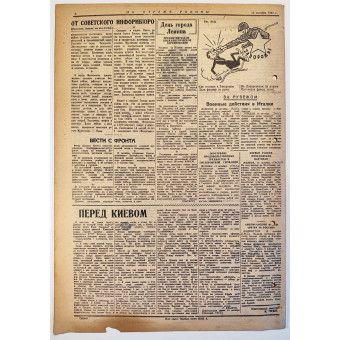
(New strikes by the anti-Hitler allies)
British aviation delivered a heavy blow to the city of Kassel.
Bombers dropped thousands of bombs on military targets.
Fires and explosions broke out, factories and rail junctions were destroyed.
In Italy the Allies continued their offensive, bombing retreating German troops.
American pilots acted by day, the British by night.
All strikes were accurate, targets destroyed.
About Assistants, Campfires, and Rockets
Red Army soldiers must remember that the commander’s assistant plays an important role in battle.
He must observe, help the commander, and quickly transmit orders.
Campfires in positions should be made only under cover so the enemy cannot spot them.
Signals should be given with flares, but only on command.
Discipline and strict fulfillment of orders ensure success.
German Anti-Tank Mine (type R.Mi.-43)
In recent months new German anti-tank mines appear more often at the front.
The R.Mi.-43 mine is a cylindrical tin box about 30 cm in diameter.
The top has a lid and four sockets for fuses.
When a tank runs over the mine, the lid bends and one of the fuses triggers.
The charge is up to 6 kilograms of TNT.
For carrying it has a metal handle.
Sappers must exercise extreme caution when clearing them.
Mediocre…
(Satire)
In the German army mediocrity is elevated to virtue.
Generals unable to fight receive awards.
Commanders who squander thousands of soldiers become “heroes of the Reich.”
Such are Hitler’s laws: obedience is valued higher than reason.
Let divisions perish, so long as the salute is given on time.
But war is not a parade.
Soviet warriors are breaking the back of fascist mediocrity.
Through All Obstacles…
Red Army soldiers fight with unprecedented courage.
Neither rivers, nor swamps, nor fire will stop them.
They advance under enemy fire, through wire barriers, through minefields.
Every day new heroes are born, who with their chests carve the path to victory.
Battle Trophies
In the last few days our forces captured rich trophies from the enemy:
— 24 tanks,
— 67 guns,
— 140 machine guns,
— thousands of rifles and large quantities of ammunition.
All of this will be turned against the enemy.
Meeting of Komsomol Workers
In the Red Army House a meeting of Komsomol workers took place.
Issues of youth combat activity were discussed.
Decisions were made to further strengthen discipline and to actively aid the front.
Speakers noted the heroism of Komsomol members at the front and in the rear.
In the Kirishi Area
Our units are conducting reconnaissance in force.
Enemy movement was noted at the forward edge.
Our artillery opened fire and destroyed enemy firing points.
The Germans suffered losses in manpower.
A Cheerful Picture
(Satire)
In one German unit the commander ordered soldiers to attack across a river.
The river was deep, there were no bridges.
The soldiers stood on the bank, not daring to enter the water.
The commander shouted: “Forward! For the Reich!”
But he himself remained on the shore.
The soldiers climbed into the water.
The current carried them away.
Many drowned.
Then the commander declared: “I am proud of you. You proved loyalty to Hitler.”
Such a cheerful picture: Germans dying in vain, while their commanders receive crosses.
Heavy Losses of German Aviation
In recent days Soviet fighters have shot down more than 80 enemy aircraft.
The Germans tried to break through to our rear but were met with fire.
Guards pilots especially distinguished themselves.
They fought against superior enemy forces and emerged victorious.
In air battles our aces showed courage and skill.
The Courage of a Gunner
During battle one of our guns was knocked out.
Gunner Sergeant Boyko was left alone.
He replaced the crew himself, opened fire, and knocked out two German tanks.
He then shifted fire onto enemy infantry and stopped their attack.
For his bravery Sergeant Boyko is recommended for an award.
The Feat of the Sappers
At night a group of sappers received orders to clear mines from a road.
Our infantry was advancing ahead.
The sappers worked under fire.
They neutralized dozens of mines and cleared the way for tanks.
At dawn our units attacked and broke through.
The sappers showed an example of courage and endurance.
For the Glory of the Motherland
In battle Red Army soldier Kuznetsov rose with the cry “For the Motherland!” and led his squad in an attack.
The enemy faltered and began to retreat.
Our fighters captured an enemy machine gun and turned it against the Germans.
Kuznetsov’s feat inspired the entire battalion.
A Funny Incident
(Satire)
At a market in a German town an order appeared:
every resident must hand over all pots and pans “for the needs of the front.”
Housewives wept: nothing left to cook with.
Then the authorities declared: “You can cook in helmets.”
And so German women cooked soups in their husbands’ helmets.
Such is the “great Reich”: instead of victories — empty pots.
From the Artillery Diary
— In the morning the battery fired at enemy concentrations in a village.
Shells hit houses, a fire started.
Apparently there was an ammo depot — an explosion followed.
— After noon our artillery destroyed a dugout and eliminated a machine-gun point.
— In the evening battery fire dispersed a column of enemy infantry.
The artillery diary is full of examples of accurate and destructive fire.
Heroes of the Front
— Red Army soldier Lebedev carried an important report to the commander of a neighboring company under heavy fire.
— Sergeant Major Egorov evacuated a group of wounded soldiers from under fire.
— Red Army soldier Ilyin destroyed an enemy machine gun with an accurate grenade throw.
The names of heroes are inscribed in the history of military glory.