Your shopping cart is empty!
« back
« back
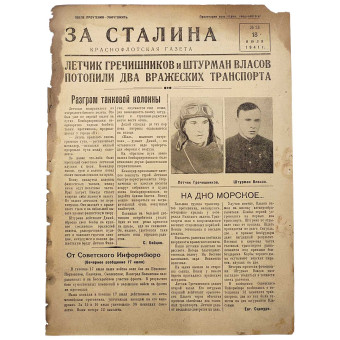
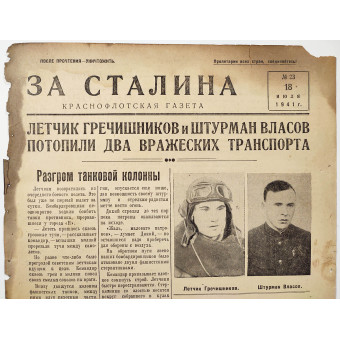
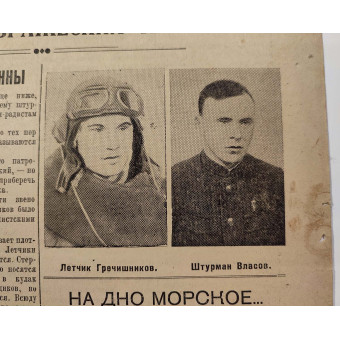
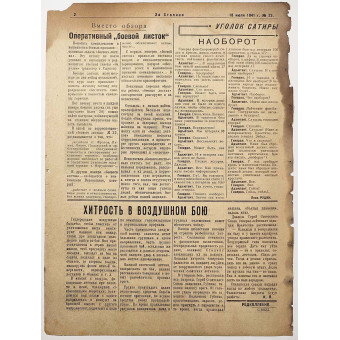
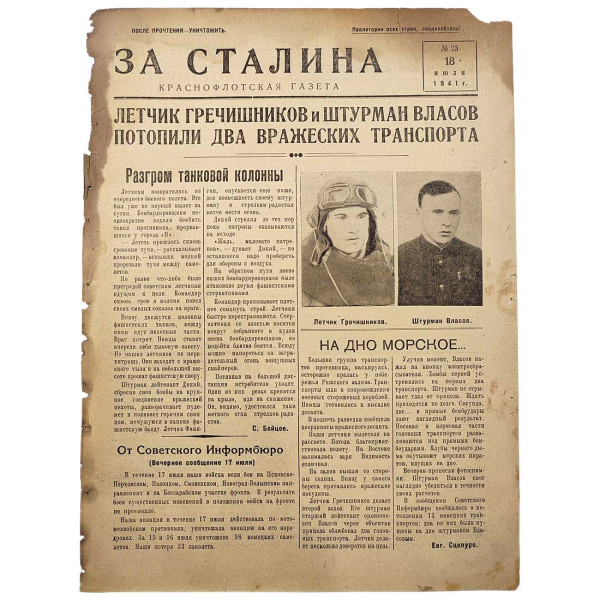
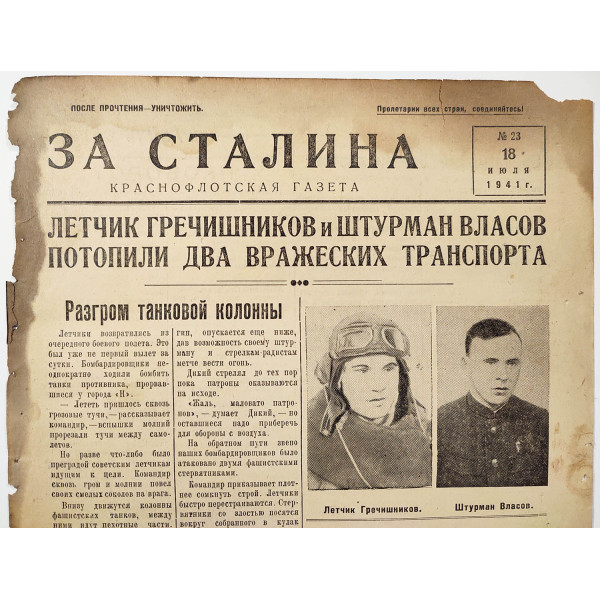
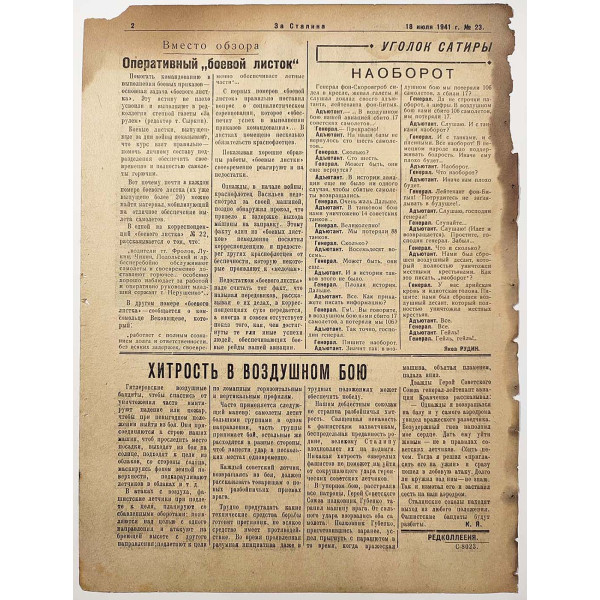
Red Navy newspaper "For Stalin" dated July 18, 1941
FOR STALIN
Red Navy Newspaper
No. 23 – July 18, 1941
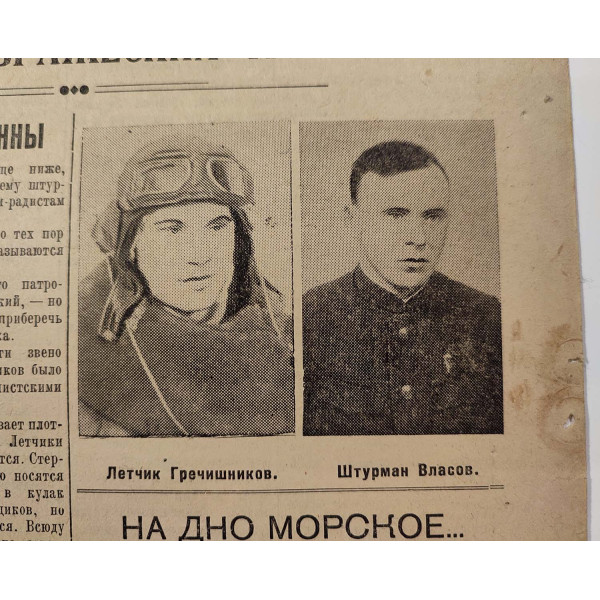
Pilot Grechishnikov and Navigator Vlasov Sank Two Enemy Transports
Destruction of a Tank Column
The pilots were returning from another combat mission. It was already their first sortie of the day. The bombers had repeatedly flown to attack the enemy’s tanks that had broken through to the outskirts of the city “N.”
“We had to descend through storm clouds,” recalls the commander. “A lightning flash illuminated the tanks crawling below, between the smoke of explosions. The enemy was cunning. He was trying to hide behind the thunderstorm. But we outwitted the enemy.”
The navigator accurately dropped bombs onto the enemy infantry concentration, dispersing their formation. The entire unit of fascist tanks, retreating in panic, was destroyed. The pilot skillfully maneuvered through the storm clouds, pressing down lower, giving his navigator and gunners-radiomen the chance to fire accurately.
Diving, he fired until his ammunition was exhausted.
“Just a few rounds left,” thought Lieutenant D., deciding to finish the remaining enemy from the air.
Turning back again, the squadron’s bombers attacked the German tanks’ assembly point. The commander signaled the pilots to prepare for attack.
The Germans were pressing their infantry onto the roads. The pilots struck again. The enemy panicked. The tanks burned, explosions rumbled.
The column was destroyed. The assignment was fulfilled. The pilots returned to base.
S. Boitsov
From the Soviet Information Bureau (Evening report, July 17)
Throughout July 17 our forces fought battles on the Pskov-Porkhov, Lida, Smolensk, Novograd-Volynsky, and Bessarabian sectors of the front. As a result of the fighting, no major changes occurred.
During the day of July 17, our aviation continued its operations against enemy troops, destroying aviation at their airfields. From July 15 to 16 inclusive, our airmen destroyed 98 enemy aircraft. Our losses – 23 aircraft.
To the Bottom of the Sea…
A large group of enemy transports, disguised as neutral ships, was heading along the Riga Gulf. They were escorted by German patrol vessels.
Our reconnaissance coordinated the attack.
Our aircraft flew out to intercept. At the head – Pilot Grechishnikov and Navigator Vlasov.
“Now!” Vlasov caught the moment and signaled the attack.
Bombs rained down. One transport was engulfed in flames.
Another went down stern first into the depths. Enemy sailors rushed into the water.
The patrol vessels scattered. Smoke and fire spread over the gulf waters.
The first great victory of our naval aviation!
In the evening, a rally was held. Grechishnikov and Vlasov reported to the squadron about their successful combat mission.
Soviet people will forever remember the names of these heroes.
Evg. Stepanov
Page 2
Instead of a Review – Operational “Combat Leaflet”
Pilots, commanders – the fulfillment of combat assignments is the main task of the “combat leaflet.” This leaflet does not tolerate excuses or delays. It is the commander’s order written on paper.
A combat leaflet raises the will, strengthens combat morale, inspires to feats. In it the front-line comrades share combat experience.
The leaflet teaches what is most important to the airman in battle: courage, composure, skill. It directs the young airman, hardens him, teaches him to beat the fascist enemy mercilessly.
The “combat leaflet” is a weapon of Bolshevik ideological education. It organizes, mobilizes, and inspires to heroism.
B. Sarnin
Corner of Satire – THE OTHER WAY AROUND
General von Skoroberg sits and ponders, wrinkling his forehead. The situation at the Soviet-German front is extraordinary.
Adjutant: “Comrade General! Reports from the front.”
General: “Read.”
Adjutant: “We lost 106 tanks in battles. Half the infantry division wiped out. Five planes left.”
General: “That’s not good. Read more.”
Adjutant: “In the history of wars there has never been such a rout.”
General: “History should be rewritten.”
Adjutant: “Our divisions surrounded.”
General: “So what? Write that we have encircled the Russians.”
Adjutant: “What shall we do with the troops, General?”
General: “The troops should hold out until winter.”
Adjutant: “But this is summer, General.”
General: “So write that it’s winter already.”
Adjutant: “General, shall I write that our army is retreating?”
General: “No. Write that it is making an organized maneuver.”
Adjutant: “General, but we lost all the tanks.”
General: “Then write we still have tanks, only invisible ones.”
Adjutant: “General, the Fuehrer is furious.”
General: “That’s a lie. Write that he’s happy.”
Yakov Rudin
Cunning in Air Combat
Hitler’s pilots often try to escape destruction by sharp maneuvers, hoping to evade our pursuit.
But our falcons know many tricks of aerial combat.
During battle our pilots often let the enemy believe he has escaped, then suddenly attack from above or the side.
Sometimes our pilot pretends to be retreating, and the fascist dives after him, only to find death waiting below.
The use of height, cloud cover, sharp turns, feigned withdrawals – all this ensures victory.
Our falcons are skillful, resourceful, cunning, and merciless.
Page 3
Letter from Sailors of the Northern Fleet
We, sailors of the North, send greetings to our comrades fighting on the Baltic, the Black Sea, and the Danube. The enemy is common, the cause is one – to smash fascism.
The Nazis will not pass!
Our bombers hit enemy convoys, our submariners sink transports. On land, our infantry fight stubbornly.
Long live the unity of Red Army, Navy, and Air Force!
Poem
The sky is roaring, the battle is raging,
Soviet falcons fly forward,
Over the Baltic the fascist foe
Will find his fiery grave.
Page 4
From the Frontlines
Our artillerymen destroyed more than 20 tanks in one day.
On another sector, cavalry units cut off enemy supply routes.
At night, our bombers raided enemy airfields, setting fire to hangars and fuel depots.
The Soviet people give everything for victory. Workers and collective farmers send gifts to the front.
Final word:
We will smash the fascist beast!
Death to the German occupiers!
Description
FOR STALIN
Red Navy Newspaper
No. 23 – July 18, 1941
Pilot Grechishnikov and Navigator Vlasov Sank Two Enemy Transports
Destruction of a Tank Column
The pilots were returning from another combat mission. It was already their first sortie of the day. The bombers had repeatedly flown to attack the enemy’s tanks that had broken through to the outskirts of the city “N.”
“We had to descend through storm clouds,” recalls the commander. “A lightning flash illuminated the tanks crawling below, between the smoke of explosions. The enemy was cunning. He was trying to hide behind the thunderstorm. But we outwitted the enemy.”
The navigator accurately dropped bombs onto the enemy infantry concentration, dispersing their formation. The entire unit of fascist tanks, retreating in panic, was destroyed. The pilot skillfully maneuvered through the storm clouds, pressing down lower, giving his navigator and gunners-radiomen the chance to fire accurately.
Diving, he fired until his ammunition was exhausted.
“Just a few rounds left,” thought Lieutenant D., deciding to finish the remaining enemy from the air.
Turning back again, the squadron’s bombers attacked the German tanks’ assembly point. The commander signaled the pilots to prepare for attack.
The Germans were pressing their infantry onto the roads. The pilots struck again. The enemy panicked. The tanks burned, explosions rumbled.
The column was destroyed. The assignment was fulfilled. The pilots returned to base.
S. Boitsov
From the Soviet Information Bureau (Evening report, July 17)
Throughout July 17 our forces fought battles on the Pskov-Porkhov, Lida, Smolensk, Novograd-Volynsky, and Bessarabian sectors of the front. As a result of the fighting, no major changes occurred.
During the day of July 17, our aviation continued its operations against enemy troops, destroying aviation at their airfields. From July 15 to 16 inclusive, our airmen destroyed 98 enemy aircraft. Our losses – 23 aircraft.
To the Bottom of the Sea…
A large group of enemy transports, disguised as neutral ships, was heading along the Riga Gulf. They were escorted by German patrol vessels.
Our reconnaissance coordinated the attack.
Our aircraft flew out to intercept. At the head – Pilot Grechishnikov and Navigator Vlasov.
“Now!” Vlasov caught the moment and signaled the attack.
Bombs rained down. One transport was engulfed in flames.
Another went down stern first into the depths. Enemy sailors rushed into the water.
The patrol vessels scattered. Smoke and fire spread over the gulf waters.
The first great victory of our naval aviation!
In the evening, a rally was held. Grechishnikov and Vlasov reported to the squadron about their successful combat mission.
Soviet people will forever remember the names of these heroes.
Evg. Stepanov
Page 2
Instead of a Review – Operational “Combat Leaflet”
Pilots, commanders – the fulfillment of combat assignments is the main task of the “combat leaflet.” This leaflet does not tolerate excuses or delays. It is the commander’s order written on paper.
A combat leaflet raises the will, strengthens combat morale, inspires to feats. In it the front-line comrades share combat experience.
The leaflet teaches what is most important to the airman in battle: courage, composure, skill. It directs the young airman, hardens him, teaches him to beat the fascist enemy mercilessly.
The “combat leaflet” is a weapon of Bolshevik ideological education. It organizes, mobilizes, and inspires to heroism.
B. Sarnin
Corner of Satire – THE OTHER WAY AROUND
General von Skoroberg sits and ponders, wrinkling his forehead. The situation at the Soviet-German front is extraordinary.
Adjutant: “Comrade General! Reports from the front.”
General: “Read.”
Adjutant: “We lost 106 tanks in battles. Half the infantry division wiped out. Five planes left.”
General: “That’s not good. Read more.”
Adjutant: “In the history of wars there has never been such a rout.”
General: “History should be rewritten.”
Adjutant: “Our divisions surrounded.”
General: “So what? Write that we have encircled the Russians.”
Adjutant: “What shall we do with the troops, General?”
General: “The troops should hold out until winter.”
Adjutant: “But this is summer, General.”
General: “So write that it’s winter already.”
Adjutant: “General, shall I write that our army is retreating?”
General: “No. Write that it is making an organized maneuver.”
Adjutant: “General, but we lost all the tanks.”
General: “Then write we still have tanks, only invisible ones.”
Adjutant: “General, the Fuehrer is furious.”
General: “That’s a lie. Write that he’s happy.”
Yakov Rudin
Cunning in Air Combat
Hitler’s pilots often try to escape destruction by sharp maneuvers, hoping to evade our pursuit.
But our falcons know many tricks of aerial combat.
During battle our pilots often let the enemy believe he has escaped, then suddenly attack from above or the side.
Sometimes our pilot pretends to be retreating, and the fascist dives after him, only to find death waiting below.
The use of height, cloud cover, sharp turns, feigned withdrawals – all this ensures victory.
Our falcons are skillful, resourceful, cunning, and merciless.
Page 3
Letter from Sailors of the Northern Fleet
We, sailors of the North, send greetings to our comrades fighting on the Baltic, the Black Sea, and the Danube. The enemy is common, the cause is one – to smash fascism.
The Nazis will not pass!
Our bombers hit enemy convoys, our submariners sink transports. On land, our infantry fight stubbornly.
Long live the unity of Red Army, Navy, and Air Force!
Poem
The sky is roaring, the battle is raging,
Soviet falcons fly forward,
Over the Baltic the fascist foe
Will find his fiery grave.
Page 4
From the Frontlines
Our artillerymen destroyed more than 20 tanks in one day.
On another sector, cavalry units cut off enemy supply routes.
At night, our bombers raided enemy airfields, setting fire to hangars and fuel depots.
The Soviet people give everything for victory. Workers and collective farmers send gifts to the front.
Final word:
We will smash the fascist beast!
Death to the German occupiers!
Payment & Delivery