Your shopping cart is empty!
« back
« back
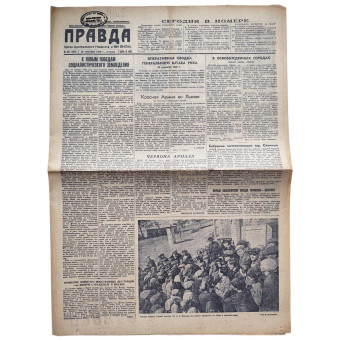
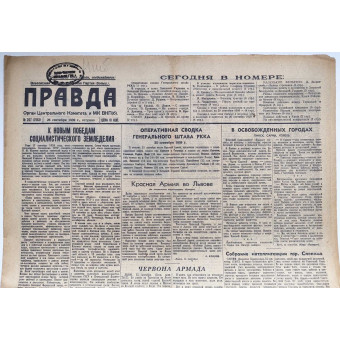
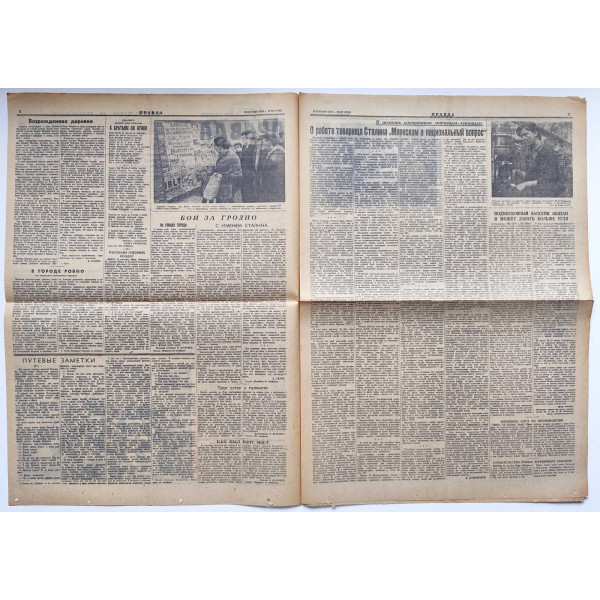
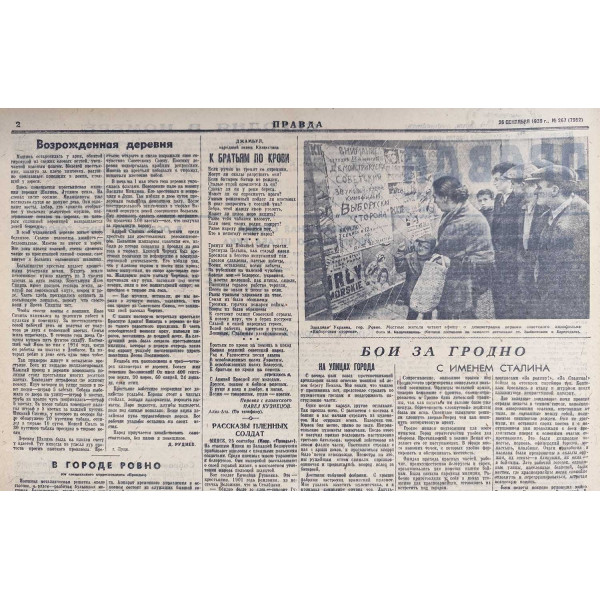

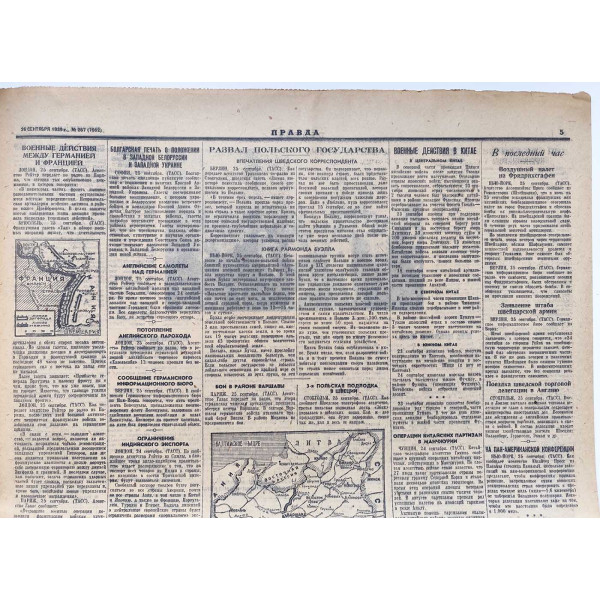
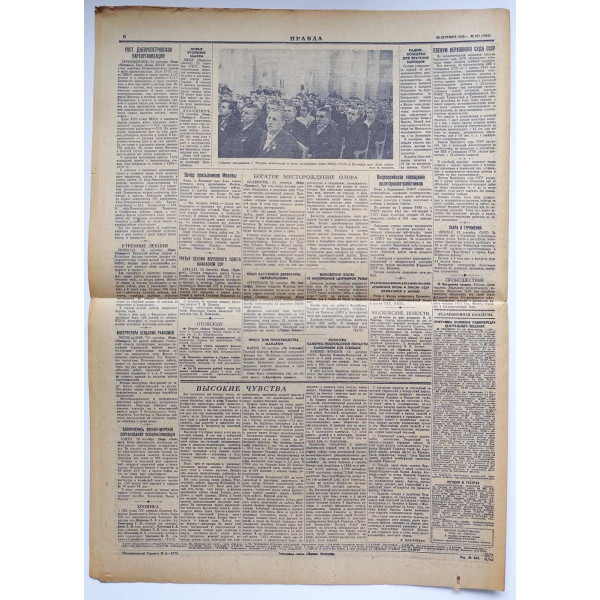
The Central Committee newspaper "Pravda", September 26, 1939
Product Code: a16/77
Out of stock
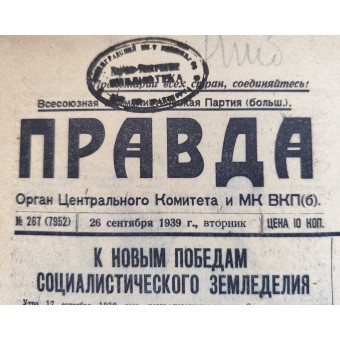
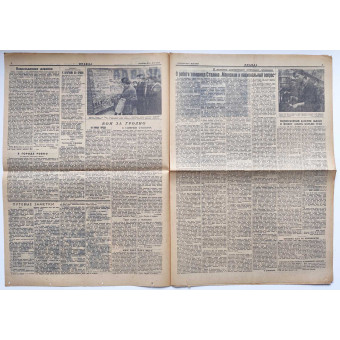
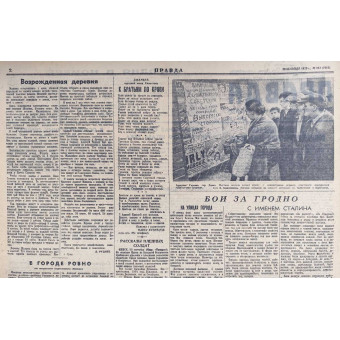
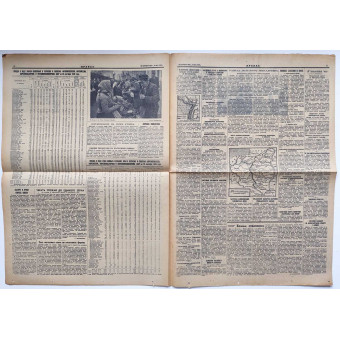
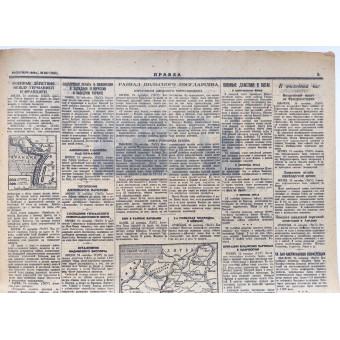
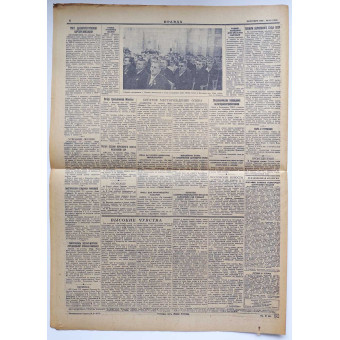
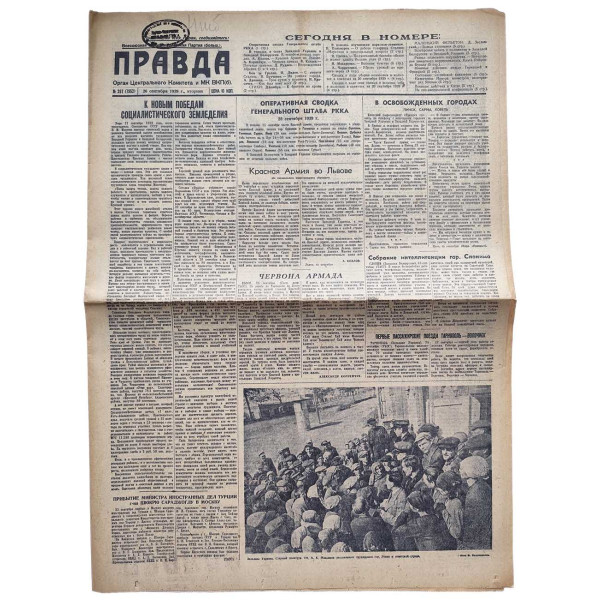
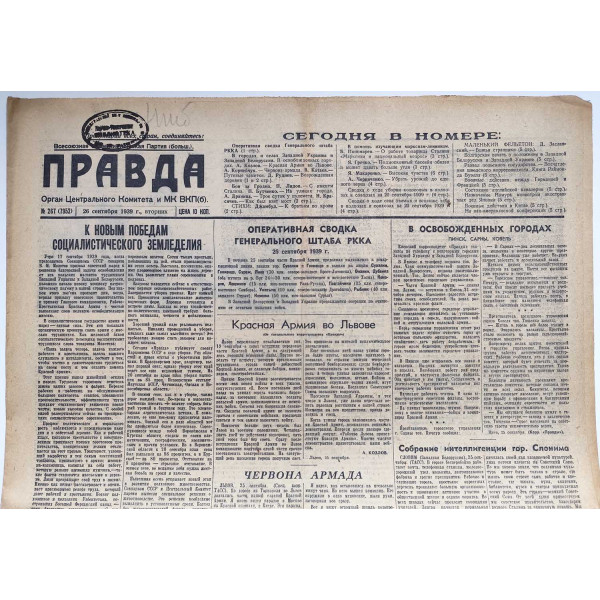
This issue of Pravda, dated September 26, 1939, is a historic document covering the entry of the Red Army into Western Ukraine and Western Belarus. The main focus is the liberation of Lvov, as well as other major cities such as Pinsk, Sarny, and Kovel, following the Soviet-Polish border redefinition in accordance with the Molotov–Ribbentrop Pact. The articles describe in detail the enthusiastic welcome of Soviet troops by local populations, the dismantling of Polish military structures, and the rapid formation of new administrative and social frameworks. The newspaper reflects the ideological framing of these events as a reunification of Slavic peoples under the Soviet Union and a triumph of socialism. This is one of the most significant wartime issues of Pravda, marking the geopolitical transformation of Eastern Europe in September 1939.
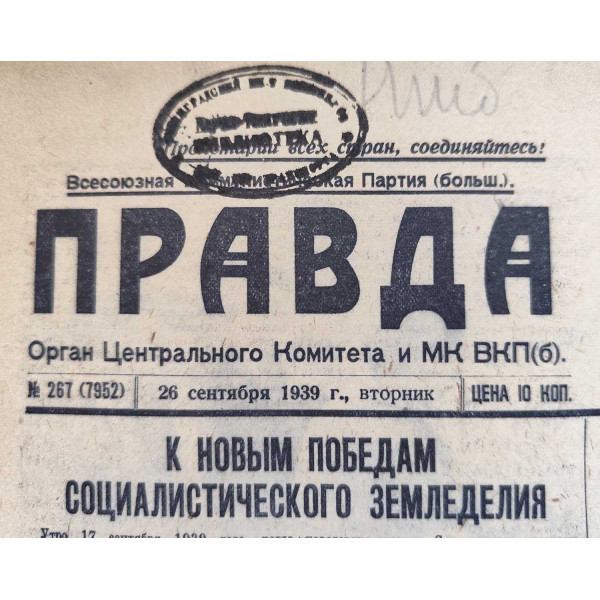
PRAVDA
Organ of the Central Committee and the Moscow Committee of the VKP(b)
No. 267 (7952) — Tuesday, September 26, 1939 — Price: 10 kopecks
Proletarians of all countries, unite!
Toward New Victories in Socialist Agriculture
On September 17, 1939, when the Red Army crossed the border to liberate the peoples of Western Belarus and Western Ukraine, it did so with the full support of the working masses and peasants. Now, at the time of harvest and field work, the Soviet countryside greets the advance of socialism in the West with renewed enthusiasm.
State farms, machine-tractor stations, and collective farms are successfully carrying out the tasks set by the Party and the government. Massive tractor brigades and agricultural shock workers are completing harvesting and sowing campaigns with record speed.
Reports from around the country highlight the mobilization of rural youth, women, and elderly workers in the collective effort. Everywhere there is a deep understanding of the international significance of the Red Army's historic march to reunify Ukrainian and Belarusian peoples.
Operational Report of the General Staff of the Workers' and Peasants' Red Army (RKKA)
September 25, 1939
On September 25, Red Army troops advanced and occupied the following towns and villages in Western Ukraine and Belarus:
-
Pinsk,
-
Sarny,
-
Kovel,
-
Dubno,
-
Lutsk,
-
Brest,
-
Kamen-Kashirsky,
-
Lyuboml,
-
Zdolbunov,
-
Rivne,
-
Ostroh,
-
Korets,
-
Shepetivka,
-
Slavuta,
-
Proskurov,
-
Starokonstantinov,
-
Volochysk,
-
Pervomaysk,
-
Podolsk,
-
Balta.
The population of the liberated cities met the Red Army with joy, bringing bread and salt, and welcoming the soldiers as liberators.
The Red Army in Lvov
(From a special correspondent of Pravda)
Lvov is experiencing unforgettable days.
On September 19, the vanguard units of the Red Army entered the city, followed the next day by the main forces. It's hard to describe the reception that greeted the Soviet troops — a heartfelt welcome from the city’s workers for the soldiers, commanders, and political officers of the Red Army.
The arrival of the Red Army is seen by all as the end of the war and the horrors that accompanied it. Just a few days earlier, the streets of the city were blocked with barricades, behind which stood Polish troops and elements of German units. Today, these barricades have been dismantled. Polish soldiers refused to fight the Red Army and chose instead to surrender — thus ending the war.
Lvov had been under martial law for over two weeks. The water supply had been down for four days, and for five days there was no electricity. As soon as the Red Army entered the city, repairs began. The water system was restored, and the power supply was partially restored the following day.
This made a profound impression on the city’s population.
Only a few days earlier, the streets had been deserted. People were hiding in basements, fearing new waves of bombing. Families had huddled in shelters, workers were unable to reach their workplaces. Now the streets are full of life again — with passersby, young people, children. Red Army troops walk with restraint and warmth. Soviet officers are flooded with questions.
The population of Western Ukraine — including Lvov — had long stopped believing the poisonous tales about our country. Despite all obstacles, the truth still found its way.
When Red Army columns filled the streets, spontaneous rallies erupted. For the first time in a long while, slogans rang out: “The workers of Lvov warmly welcome the Red Army!” Thousands joined the demonstration to greet our soldiers.
A. Kozlov
Lvov, September 25
In the Liberated Cities
(Pinsk, Sarny, Kovel)
A Pravda correspondent in Kiev contacted several cities in Western Ukraine and Western Belarus by telephone.
In Pinsk: Comrade Dolokh, a Communist Party member from Western Belarus and a former underground activist, is now serving on the temporary city council. He reported:
— Red Army units entered Pinsk on September 21. The city welcomed them as liberators. Order was restored immediately.
A temporary city administration has been established to restore order in the war-torn city following the retreat of Polish forces.
The administration’s first task is to clean up the city, remove the effects of previous occupation, and begin employing the unemployed. There are many homeless and jobless people in the city — the new administration is already addressing this.
Shops have reopened in Pinsk. Schools are preparing to resume lessons. A number of enterprises and workshops have reopened. Theater performances have resumed, and Soviet films are being shown in cinemas to enthusiastic audiences. The streets are lively, crowded. Soldiers and Red Army commanders are treated with great respect.
In Sarny: Two sawmills, a flour mill, and several large enterprises are already running again. Local bakeries and even a sawmill are reopening. Shops are functioning again. Food is available on the markets. Almost all shops have reopened.
The city council, according to Comrade Pishchuk, has already reconnected telephones and is sending telegrams in Ukrainian, Russian, and Belarusian. Schools are reopening, and contact with nearby villages has resumed.
In Kovel: Comrade Tishchenko of the city council reported:
— Life is returning to normal. Shops are opening. Peasants are bringing their goods to the markets.
Committees of workers and craftspeople have been formed. One group of workers informed the city council they had created a committee to oversee cultural life. A new newspaper, Kovelskaya Pravda, is publishing its first issue. A club will open soon.
Peasants and workers are united in building a new life. Schools and libraries are reopening. Government offices and Polish police stations are now being used by the local Soviets.
— We’re printing our first newspaper, — said Tishchenko. — Soon we’ll have a full Soviet paper entirely in the local language.
Kiev, September 23
Meeting of the Intelligentsia of the City of Slonim
On September 25, a meeting of writers, doctors, and teachers was held in the town of Slonim. A resolution was passed expressing full support for the actions of the Soviet government and the Red Army. Writers spoke of the importance of uniting the Ukrainian people and rebuilding their culture free from Polish and bourgeois oppression.
Description
This issue of Pravda, dated September 26, 1939, is a historic document covering the entry of the Red Army into Western Ukraine and Western Belarus. The main focus is the liberation of Lvov, as well as other major cities such as Pinsk, Sarny, and Kovel, following the Soviet-Polish border redefinition in accordance with the Molotov–Ribbentrop Pact. The articles describe in detail the enthusiastic welcome of Soviet troops by local populations, the dismantling of Polish military structures, and the rapid formation of new administrative and social frameworks. The newspaper reflects the ideological framing of these events as a reunification of Slavic peoples under the Soviet Union and a triumph of socialism. This is one of the most significant wartime issues of Pravda, marking the geopolitical transformation of Eastern Europe in September 1939.
PRAVDA
Organ of the Central Committee and the Moscow Committee of the VKP(b)
No. 267 (7952) — Tuesday, September 26, 1939 — Price: 10 kopecks
Proletarians of all countries, unite!
Toward New Victories in Socialist Agriculture
On September 17, 1939, when the Red Army crossed the border to liberate the peoples of Western Belarus and Western Ukraine, it did so with the full support of the working masses and peasants. Now, at the time of harvest and field work, the Soviet countryside greets the advance of socialism in the West with renewed enthusiasm.
State farms, machine-tractor stations, and collective farms are successfully carrying out the tasks set by the Party and the government. Massive tractor brigades and agricultural shock workers are completing harvesting and sowing campaigns with record speed.
Reports from around the country highlight the mobilization of rural youth, women, and elderly workers in the collective effort. Everywhere there is a deep understanding of the international significance of the Red Army's historic march to reunify Ukrainian and Belarusian peoples.
Operational Report of the General Staff of the Workers' and Peasants' Red Army (RKKA)
September 25, 1939
On September 25, Red Army troops advanced and occupied the following towns and villages in Western Ukraine and Belarus:
-
Pinsk,
-
Sarny,
-
Kovel,
-
Dubno,
-
Lutsk,
-
Brest,
-
Kamen-Kashirsky,
-
Lyuboml,
-
Zdolbunov,
-
Rivne,
-
Ostroh,
-
Korets,
-
Shepetivka,
-
Slavuta,
-
Proskurov,
-
Starokonstantinov,
-
Volochysk,
-
Pervomaysk,
-
Podolsk,
-
Balta.
The population of the liberated cities met the Red Army with joy, bringing bread and salt, and welcoming the soldiers as liberators.
The Red Army in Lvov
(From a special correspondent of Pravda)
Lvov is experiencing unforgettable days.
On September 19, the vanguard units of the Red Army entered the city, followed the next day by the main forces. It's hard to describe the reception that greeted the Soviet troops — a heartfelt welcome from the city’s workers for the soldiers, commanders, and political officers of the Red Army.
The arrival of the Red Army is seen by all as the end of the war and the horrors that accompanied it. Just a few days earlier, the streets of the city were blocked with barricades, behind which stood Polish troops and elements of German units. Today, these barricades have been dismantled. Polish soldiers refused to fight the Red Army and chose instead to surrender — thus ending the war.
Lvov had been under martial law for over two weeks. The water supply had been down for four days, and for five days there was no electricity. As soon as the Red Army entered the city, repairs began. The water system was restored, and the power supply was partially restored the following day.
This made a profound impression on the city’s population.
Only a few days earlier, the streets had been deserted. People were hiding in basements, fearing new waves of bombing. Families had huddled in shelters, workers were unable to reach their workplaces. Now the streets are full of life again — with passersby, young people, children. Red Army troops walk with restraint and warmth. Soviet officers are flooded with questions.
The population of Western Ukraine — including Lvov — had long stopped believing the poisonous tales about our country. Despite all obstacles, the truth still found its way.
When Red Army columns filled the streets, spontaneous rallies erupted. For the first time in a long while, slogans rang out: “The workers of Lvov warmly welcome the Red Army!” Thousands joined the demonstration to greet our soldiers.
A. Kozlov
Lvov, September 25
In the Liberated Cities
(Pinsk, Sarny, Kovel)
A Pravda correspondent in Kiev contacted several cities in Western Ukraine and Western Belarus by telephone.
In Pinsk: Comrade Dolokh, a Communist Party member from Western Belarus and a former underground activist, is now serving on the temporary city council. He reported:
— Red Army units entered Pinsk on September 21. The city welcomed them as liberators. Order was restored immediately.
A temporary city administration has been established to restore order in the war-torn city following the retreat of Polish forces.
The administration’s first task is to clean up the city, remove the effects of previous occupation, and begin employing the unemployed. There are many homeless and jobless people in the city — the new administration is already addressing this.
Shops have reopened in Pinsk. Schools are preparing to resume lessons. A number of enterprises and workshops have reopened. Theater performances have resumed, and Soviet films are being shown in cinemas to enthusiastic audiences. The streets are lively, crowded. Soldiers and Red Army commanders are treated with great respect.
In Sarny: Two sawmills, a flour mill, and several large enterprises are already running again. Local bakeries and even a sawmill are reopening. Shops are functioning again. Food is available on the markets. Almost all shops have reopened.
The city council, according to Comrade Pishchuk, has already reconnected telephones and is sending telegrams in Ukrainian, Russian, and Belarusian. Schools are reopening, and contact with nearby villages has resumed.
In Kovel: Comrade Tishchenko of the city council reported:
— Life is returning to normal. Shops are opening. Peasants are bringing their goods to the markets.
Committees of workers and craftspeople have been formed. One group of workers informed the city council they had created a committee to oversee cultural life. A new newspaper, Kovelskaya Pravda, is publishing its first issue. A club will open soon.
Peasants and workers are united in building a new life. Schools and libraries are reopening. Government offices and Polish police stations are now being used by the local Soviets.
— We’re printing our first newspaper, — said Tishchenko. — Soon we’ll have a full Soviet paper entirely in the local language.
Kiev, September 23
Meeting of the Intelligentsia of the City of Slonim
On September 25, a meeting of writers, doctors, and teachers was held in the town of Slonim. A resolution was passed expressing full support for the actions of the Soviet government and the Red Army. Writers spoke of the importance of uniting the Ukrainian people and rebuilding their culture free from Polish and bourgeois oppression.
Payment & Delivery