Your shopping cart is empty!
« back
« back
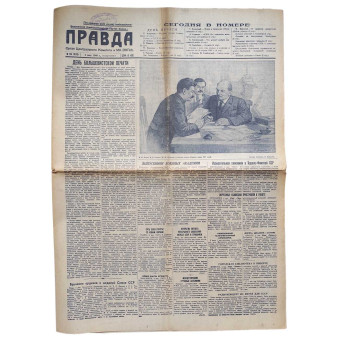
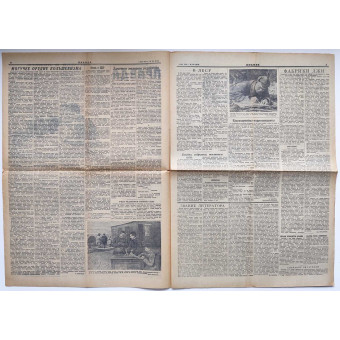

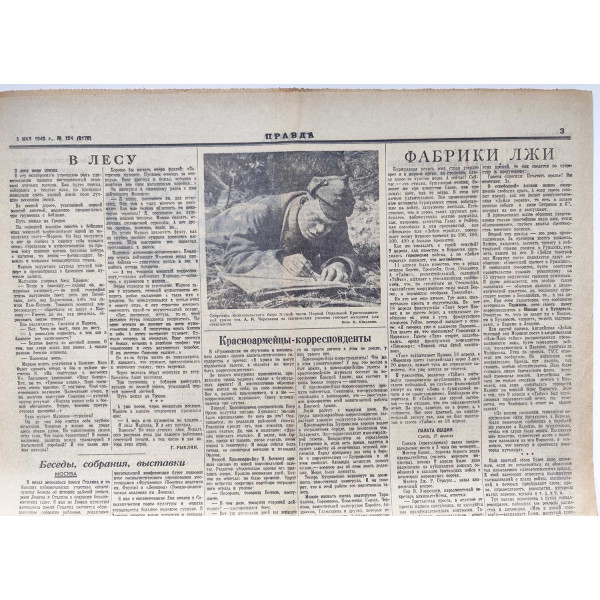
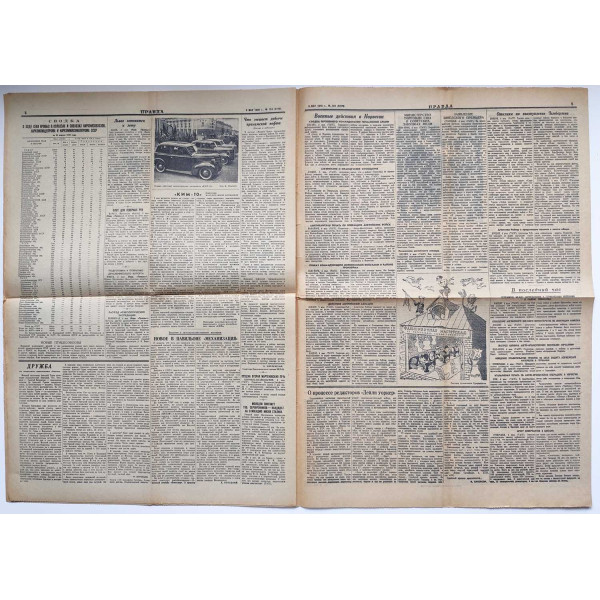

The main Soviet newspaper "Pravda", May 5, 1940
Product Code: a16/76
Out of stock
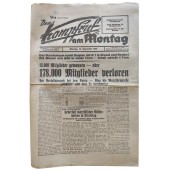
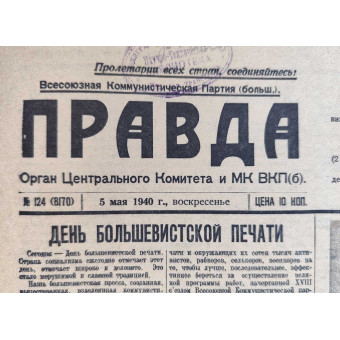
Pravda Newspaper No. 124 (8770)
May 5, 1940
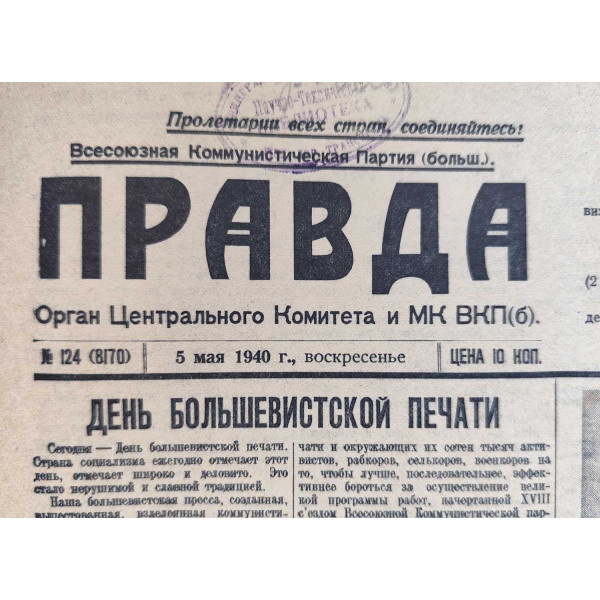
Workers of the world, unite!
Organ of the Central Committee and Moscow Committee of the All-Union Communist Party (Bolsheviks)
No. 124 (8770)
Sunday, May 5, 1940
Price 10 kopeks
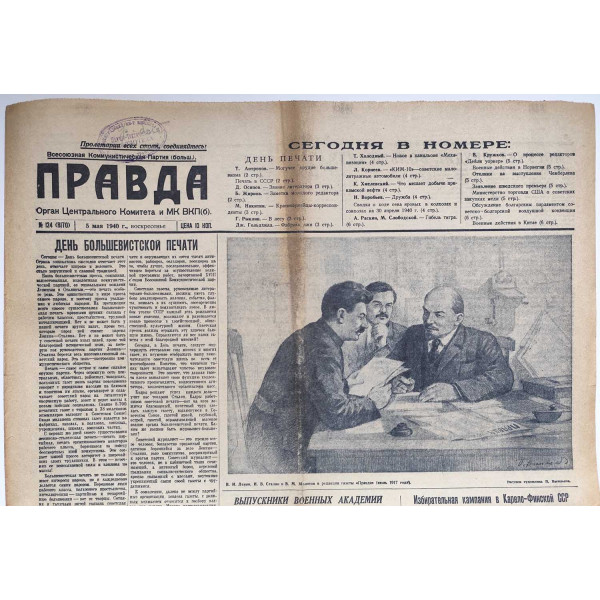
Today in the Issue:
T. Antipov — The Mighty Weapon of Bolshevism
The Press in the USSR
D. Osipov — The Role of a Writer
B. Zhirov — Notes of a Young Editor
M. Nikitin — Red Army Soldiers as Correspondents
G. Ryazhkin — In the Forest
Dm. Goldmain — Factories of Lies
T. Kholodnaya — New in the Pavilion of “Mechanization”
L. Kornev — “KIM-10” — Soviet Small Cars
K. Zheleznyakov — What Hinders Baltic Oil Production
N. Vorobyov — Friendship
Summary on Spring Sowing as of April 30, 1940
A. Raskin, M. Svobodskoy — The Death of a Tiger
V. Krutskoy — On the Profession of “Daily Worker” Editors
Military Operations in Norway
Responses to Chamberlain’s Speech
Statement of the Swedish Prime Minister
The US Department of Commerce on Soviet Copper Purchases
Discussion in the Bulgarian Parliament on the Soviet-Bulgarian Air Convention
Military Actions in China
Day of Bolshevik Press
Today is the Day of Bolshevik Press. The vast socialist country celebrates this day, paying attention to the significance of the press, deeply rooted in the very depths of society.
Our Bolshevik press, created directly within the people, nurtured by the great revolutionaries Lenin and Stalin, embodies the mighty strength of socialist society. It reflects the heroism and labor feats of the peoples of the USSR, the full power and might of the socialist state.
The bourgeois press, whose venality and falseness have been exposed by millions of facts, cannot be compared with our newspaper. There is no place for fabrications and slander in it.
The Bolshevik press is the Party’s most important weapon. It educates the masses, arms them with knowledge, raises their consciousness and activity.
The Soviet press is an organ of truth. Its authority grows throughout the world, it enjoys the trust and respect of all progressive humanity.
During the first Russian Revolution Lenin wrote: “A newspaper is not only a collective propagandist and a collective agitator, but also a collective organizer.”
With this Leninist definition begins the history of the Bolshevik press. And in our days, it fully justifies this great Leninist definition.
The newspaper lives one life with the people, reflects its joys and concerns, expresses its interests and aspirations.
The Party of Lenin and Stalin cares for the further growth and strengthening of the Bolshevik press. The 18th Congress of the VKP(b) noted the outstanding role of the press and pointed out the need for its further development.
The Soviet press, guided by the Party, is closely connected with the masses. It delves deeply into their lives, carefully listens to their voice. Its materials are marked by partisanship, truthfulness, and passionate conviction.
The Bolshevik press, being a mighty weapon of socialist society, helps the Party and the government lead the Soviet people to new victories and achievements.
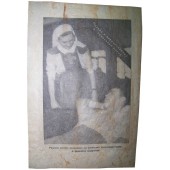
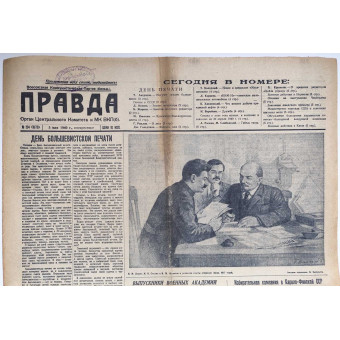
(Caption under the illustration)
V. I. Lenin, J. V. Stalin, and V. M. Molotov in the editorial office of Pravda (July 1917).
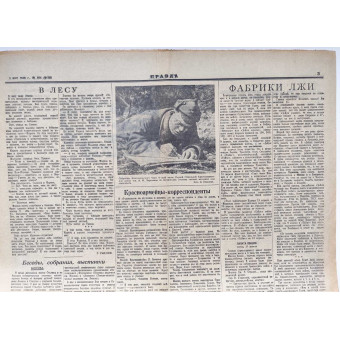
In the Forest
By G. Ryazhkin
In winter the birds flew away. And now, in the birch grove, they have returned again and arranged bird concerts once more. The forest thicket has filled with cheerful chirping. In these days Red Army soldiers are carrying out tactical exercises. In the grove other voices are heard: commands, shots.
Along a forest road, covered with last year’s leaves, a rifle unit is moving. Ahead goes the commander with binoculars.
The route is difficult. The soldiers must overcome blockages, swamps, groves. But then a wide clearing appears ahead.
“Rest halt,” orders the commander.
The march is over. A short rest begins. The soldiers sit in groups, cheerful conversation starts.
Soon the forest fills with a loud chorus: they sing songs — old, battle songs, and new, beloved ones.
All are laughing. Markov, the joker of the company, laughs as well.
“Come on, tell us something,” his comrades tease him.
Markov begins. The soldiers listen, laugh, interrupt with jokes.
Then the talk turns to how training is difficult, but no one spares effort.
“True,” says Markov. “And it would be boring if only the commander taught us and we silently listened. It would be good if we also wrote a newspaper ourselves, like in other companies.”
The soldiers supported the idea.
From then on, the joker Markov, the company’s main entertainer, became editor of the wall newspaper.
Soon the first combat issue appeared on the wall. On large sheets of paper, in red letters, it read: “Red Army Soldier.” Under this title short notes, poems, and caricatures were placed.
The soldiers read the newspaper and laughed merrily.
Thus the wall newspaper “Red Army Soldier” was born. Since then every exercise, every event in the company was reflected in its lines.
Red Army Soldiers as Correspondents
By M. Nikitin
The “Manual on Training and Education of the Red Army” says:
“…The army not only fights, but also learns, educates. Each Red Army soldier and junior commander must be given the opportunity during service in the Red Army to show their abilities, develop their knowledge and skills. To these aims serves the wall newspaper.”
In the division, a multi-circulation newspaper is published. Its editorial staff has its special correspondents — Red Army soldiers and junior commanders who write notes, satires, and essays. Some highlight combat training, others describe cultural activities, others write about public life.
For example, Red Army soldier T. Bondarenko describes how his comrade distinguished himself in shooting practice. And Red Army soldier B. Zhuravlyov exposes idlers hiding from duties.
Each newspaper, each article helps the cause of education, makes the fighter more conscious and cultured.
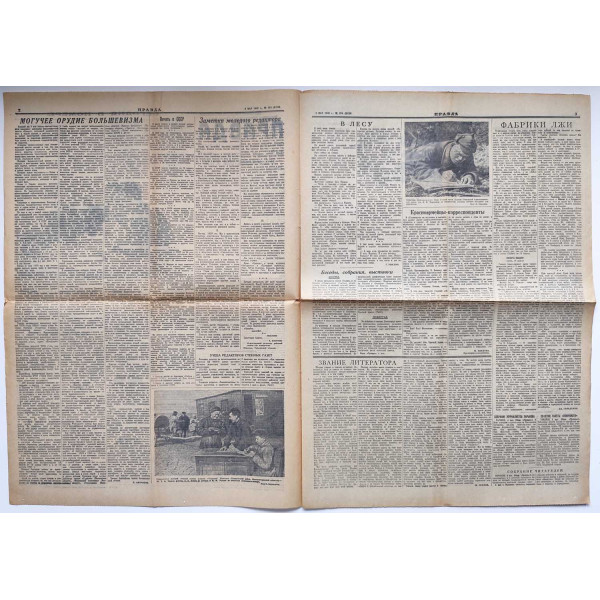
(Photo — “Secretary of the Komsomol bureau of a unit of the First Separate Red Banner Army, Comrade A. M. Chernov, during tactical exercises preparing material for the wall newspaper.”)
Factories of Lies
By Dm. Goldmain
The bourgeois press has a hundredfold increased its noise and outcry against the Soviet Union. Every word, every phrase, every document, every event is distorted and presented in a grotesque form.
The aim is clear. The bourgeois fabricators of lies strive to blacken the Soviet country, slander it, sow distrust and hostility.
There are countless examples. Any little paper in Paris or London prints such material. But especially zealous are the giants of the bourgeois press — the English and French Times, Figaro, Petit Parisien.
German newspapers print monstrous inventions about the “Bolshevik threat,” “export of revolution by the Soviets,” “Russian spies.”
Recently the Figaro newspaper published that allegedly thousands of foreigners are imprisoned in Moscow. Petit Parisien claimed that the USSR is allegedly preparing an attack on Scandinavia. Times spreads rumors about mass repressions.
All these factories of lies work around the clock. Their aim is to cover up their own aggressive actions, justify the occupation of foreign territories, justify war.
Discussions, Meetings, Exhibitions
Moscow. During Press Week the capital and nearby collective farms organized dozens of events. At the House of the Red Army an exhibition of military newspapers opened. Hundreds of discussions about the importance of the press were held in clubs and schools.
The collective farmers of the village of Lenin (Kolomna district) organized a meeting where they read and discussed the newspapers Pravda and Izvestia.
At the Lenin Library, a book exhibition was opened: “Great Leaders of the Press — Lenin and Stalin.”
Summary on Spring Sowing
(as of April 30, 1940)
The table lists the percentage of spring sowing plan fulfilled by republics:
– USSR total — 32.2%
– RSFSR — 33.7%
– Ukrainian SSR — 30.9%
– Belorussian SSR — 32.3%
– Transcaucasian SSR — 26.7%
– Azerbaijan SSR — 23.4%
– Armenian SSR — 31.1%
– Georgian SSR — 24.7%
– Kazakh SSR — 28.4%
– Central Asian republics — 27.1%
– Kirghiz SSR — 29.8%
– Tajik SSR — 28.0%
– Turkmen SSR — 24.3%
– Uzbek SSR — 26.9%
– Lithuanian SSR — 30.5%
– Latvian SSR — 29.7%
– Estonian SSR — 28.9%
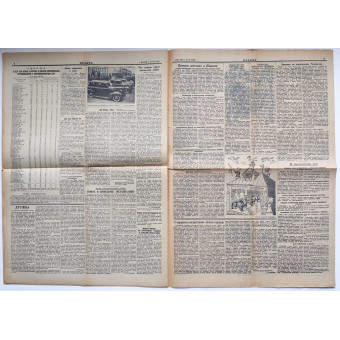
KIM-10
On the streets of Moscow new Soviet small cars KIM-10 have appeared. Their production has been established at the Moscow KIM factory. These are four-seater passenger cars with closed bodies, intended for city and suburban travel.
What Hinders Baltic Oil Production
By K. Zheleznyakov
(full article devoted to economy and resource extraction).
New in the Pavilion of “Mechanization”
By T. Kholodnaya
(report on new machines and equipment at the All-Union Agricultural Exhibition).
Friendship
By N. Vorobyov
Friendship is a great word. The friendship of the peoples of the USSR is the solid foundation of socialist brotherhood. In collective farms, state farms, and Red Army units friendship shows itself in everything: in joint work, in study, in everyday life.
Military Operations in Norway
Reports of the German and British staffs confirm fierce fighting near Narvik and Trondheim. German troops are holding Narvik; constant air raids are taking place. British sources report the landing of new British and French contingents in Norway.
US Department of Commerce on Soviet Copper Purchases
Washington. The US Department of Commerce stated that Soviet purchases of copper in the USA this year reached considerable volumes.
Statement of the Swedish Prime Minister
Stockholm. The Swedish Prime Minister declared in Parliament that Sweden would maintain a policy of strict neutrality.
Responses to Chamberlain’s Speech
Large article analyzing British policy and world press reaction.
On the Profession of “Daily Worker” Editors
By V. Krutskoy
Last Minute News
Moscow, May 4 (TASS). From London it is reported about air raids on the northern coast of Germany.
Helsinki, May 4. Debates on foreign policy issues continued in the Finnish Parliament.
Description
Pravda Newspaper No. 124 (8770)
May 5, 1940
Workers of the world, unite!
Organ of the Central Committee and Moscow Committee of the All-Union Communist Party (Bolsheviks)
No. 124 (8770)
Sunday, May 5, 1940
Price 10 kopeks
Today in the Issue:
T. Antipov — The Mighty Weapon of Bolshevism
The Press in the USSR
D. Osipov — The Role of a Writer
B. Zhirov — Notes of a Young Editor
M. Nikitin — Red Army Soldiers as Correspondents
G. Ryazhkin — In the Forest
Dm. Goldmain — Factories of Lies
T. Kholodnaya — New in the Pavilion of “Mechanization”
L. Kornev — “KIM-10” — Soviet Small Cars
K. Zheleznyakov — What Hinders Baltic Oil Production
N. Vorobyov — Friendship
Summary on Spring Sowing as of April 30, 1940
A. Raskin, M. Svobodskoy — The Death of a Tiger
V. Krutskoy — On the Profession of “Daily Worker” Editors
Military Operations in Norway
Responses to Chamberlain’s Speech
Statement of the Swedish Prime Minister
The US Department of Commerce on Soviet Copper Purchases
Discussion in the Bulgarian Parliament on the Soviet-Bulgarian Air Convention
Military Actions in China
Day of Bolshevik Press
Today is the Day of Bolshevik Press. The vast socialist country celebrates this day, paying attention to the significance of the press, deeply rooted in the very depths of society.
Our Bolshevik press, created directly within the people, nurtured by the great revolutionaries Lenin and Stalin, embodies the mighty strength of socialist society. It reflects the heroism and labor feats of the peoples of the USSR, the full power and might of the socialist state.
The bourgeois press, whose venality and falseness have been exposed by millions of facts, cannot be compared with our newspaper. There is no place for fabrications and slander in it.
The Bolshevik press is the Party’s most important weapon. It educates the masses, arms them with knowledge, raises their consciousness and activity.
The Soviet press is an organ of truth. Its authority grows throughout the world, it enjoys the trust and respect of all progressive humanity.
During the first Russian Revolution Lenin wrote: “A newspaper is not only a collective propagandist and a collective agitator, but also a collective organizer.”
With this Leninist definition begins the history of the Bolshevik press. And in our days, it fully justifies this great Leninist definition.
The newspaper lives one life with the people, reflects its joys and concerns, expresses its interests and aspirations.
The Party of Lenin and Stalin cares for the further growth and strengthening of the Bolshevik press. The 18th Congress of the VKP(b) noted the outstanding role of the press and pointed out the need for its further development.
The Soviet press, guided by the Party, is closely connected with the masses. It delves deeply into their lives, carefully listens to their voice. Its materials are marked by partisanship, truthfulness, and passionate conviction.
The Bolshevik press, being a mighty weapon of socialist society, helps the Party and the government lead the Soviet people to new victories and achievements.
(Caption under the illustration)
V. I. Lenin, J. V. Stalin, and V. M. Molotov in the editorial office of Pravda (July 1917).
In the Forest
By G. Ryazhkin
In winter the birds flew away. And now, in the birch grove, they have returned again and arranged bird concerts once more. The forest thicket has filled with cheerful chirping. In these days Red Army soldiers are carrying out tactical exercises. In the grove other voices are heard: commands, shots.
Along a forest road, covered with last year’s leaves, a rifle unit is moving. Ahead goes the commander with binoculars.
The route is difficult. The soldiers must overcome blockages, swamps, groves. But then a wide clearing appears ahead.
“Rest halt,” orders the commander.
The march is over. A short rest begins. The soldiers sit in groups, cheerful conversation starts.
Soon the forest fills with a loud chorus: they sing songs — old, battle songs, and new, beloved ones.
All are laughing. Markov, the joker of the company, laughs as well.
“Come on, tell us something,” his comrades tease him.
Markov begins. The soldiers listen, laugh, interrupt with jokes.
Then the talk turns to how training is difficult, but no one spares effort.
“True,” says Markov. “And it would be boring if only the commander taught us and we silently listened. It would be good if we also wrote a newspaper ourselves, like in other companies.”
The soldiers supported the idea.
From then on, the joker Markov, the company’s main entertainer, became editor of the wall newspaper.
Soon the first combat issue appeared on the wall. On large sheets of paper, in red letters, it read: “Red Army Soldier.” Under this title short notes, poems, and caricatures were placed.
The soldiers read the newspaper and laughed merrily.
Thus the wall newspaper “Red Army Soldier” was born. Since then every exercise, every event in the company was reflected in its lines.
Red Army Soldiers as Correspondents
By M. Nikitin
The “Manual on Training and Education of the Red Army” says:
“…The army not only fights, but also learns, educates. Each Red Army soldier and junior commander must be given the opportunity during service in the Red Army to show their abilities, develop their knowledge and skills. To these aims serves the wall newspaper.”
In the division, a multi-circulation newspaper is published. Its editorial staff has its special correspondents — Red Army soldiers and junior commanders who write notes, satires, and essays. Some highlight combat training, others describe cultural activities, others write about public life.
For example, Red Army soldier T. Bondarenko describes how his comrade distinguished himself in shooting practice. And Red Army soldier B. Zhuravlyov exposes idlers hiding from duties.
Each newspaper, each article helps the cause of education, makes the fighter more conscious and cultured.
(Photo — “Secretary of the Komsomol bureau of a unit of the First Separate Red Banner Army, Comrade A. M. Chernov, during tactical exercises preparing material for the wall newspaper.”)
Factories of Lies
By Dm. Goldmain
The bourgeois press has a hundredfold increased its noise and outcry against the Soviet Union. Every word, every phrase, every document, every event is distorted and presented in a grotesque form.
The aim is clear. The bourgeois fabricators of lies strive to blacken the Soviet country, slander it, sow distrust and hostility.
There are countless examples. Any little paper in Paris or London prints such material. But especially zealous are the giants of the bourgeois press — the English and French Times, Figaro, Petit Parisien.
German newspapers print monstrous inventions about the “Bolshevik threat,” “export of revolution by the Soviets,” “Russian spies.”
Recently the Figaro newspaper published that allegedly thousands of foreigners are imprisoned in Moscow. Petit Parisien claimed that the USSR is allegedly preparing an attack on Scandinavia. Times spreads rumors about mass repressions.
All these factories of lies work around the clock. Their aim is to cover up their own aggressive actions, justify the occupation of foreign territories, justify war.
Discussions, Meetings, Exhibitions
Moscow. During Press Week the capital and nearby collective farms organized dozens of events. At the House of the Red Army an exhibition of military newspapers opened. Hundreds of discussions about the importance of the press were held in clubs and schools.
The collective farmers of the village of Lenin (Kolomna district) organized a meeting where they read and discussed the newspapers Pravda and Izvestia.
At the Lenin Library, a book exhibition was opened: “Great Leaders of the Press — Lenin and Stalin.”
Summary on Spring Sowing
(as of April 30, 1940)
The table lists the percentage of spring sowing plan fulfilled by republics:
– USSR total — 32.2%
– RSFSR — 33.7%
– Ukrainian SSR — 30.9%
– Belorussian SSR — 32.3%
– Transcaucasian SSR — 26.7%
– Azerbaijan SSR — 23.4%
– Armenian SSR — 31.1%
– Georgian SSR — 24.7%
– Kazakh SSR — 28.4%
– Central Asian republics — 27.1%
– Kirghiz SSR — 29.8%
– Tajik SSR — 28.0%
– Turkmen SSR — 24.3%
– Uzbek SSR — 26.9%
– Lithuanian SSR — 30.5%
– Latvian SSR — 29.7%
– Estonian SSR — 28.9%
KIM-10
On the streets of Moscow new Soviet small cars KIM-10 have appeared. Their production has been established at the Moscow KIM factory. These are four-seater passenger cars with closed bodies, intended for city and suburban travel.
What Hinders Baltic Oil Production
By K. Zheleznyakov
(full article devoted to economy and resource extraction).
New in the Pavilion of “Mechanization”
By T. Kholodnaya
(report on new machines and equipment at the All-Union Agricultural Exhibition).
Friendship
By N. Vorobyov
Friendship is a great word. The friendship of the peoples of the USSR is the solid foundation of socialist brotherhood. In collective farms, state farms, and Red Army units friendship shows itself in everything: in joint work, in study, in everyday life.
Military Operations in Norway
Reports of the German and British staffs confirm fierce fighting near Narvik and Trondheim. German troops are holding Narvik; constant air raids are taking place. British sources report the landing of new British and French contingents in Norway.
US Department of Commerce on Soviet Copper Purchases
Washington. The US Department of Commerce stated that Soviet purchases of copper in the USA this year reached considerable volumes.
Statement of the Swedish Prime Minister
Stockholm. The Swedish Prime Minister declared in Parliament that Sweden would maintain a policy of strict neutrality.
Responses to Chamberlain’s Speech
Large article analyzing British policy and world press reaction.
On the Profession of “Daily Worker” Editors
By V. Krutskoy
Last Minute News
Moscow, May 4 (TASS). From London it is reported about air raids on the northern coast of Germany.
Helsinki, May 4. Debates on foreign policy issues continued in the Finnish Parliament.
Payment & Delivery